Cerebras (CBRS) IPO: How Hyperliquid Beat Wall Street to Price Discovery

May 15, 2026
By Hyperdash
Here is how on-chain perpetuals just disrupted the traditional finance pricing model, and why legacy exchanges like the CME and NYSE are suddenly very nervous.
Published
May 15, 2026
Author
Hyperdash
Reading time
5 min read
Category
Market Analysis
The largest tech IPO since Uber just executed, but the most important market signal didn't come from Nasdaq. It came from the blockchain.
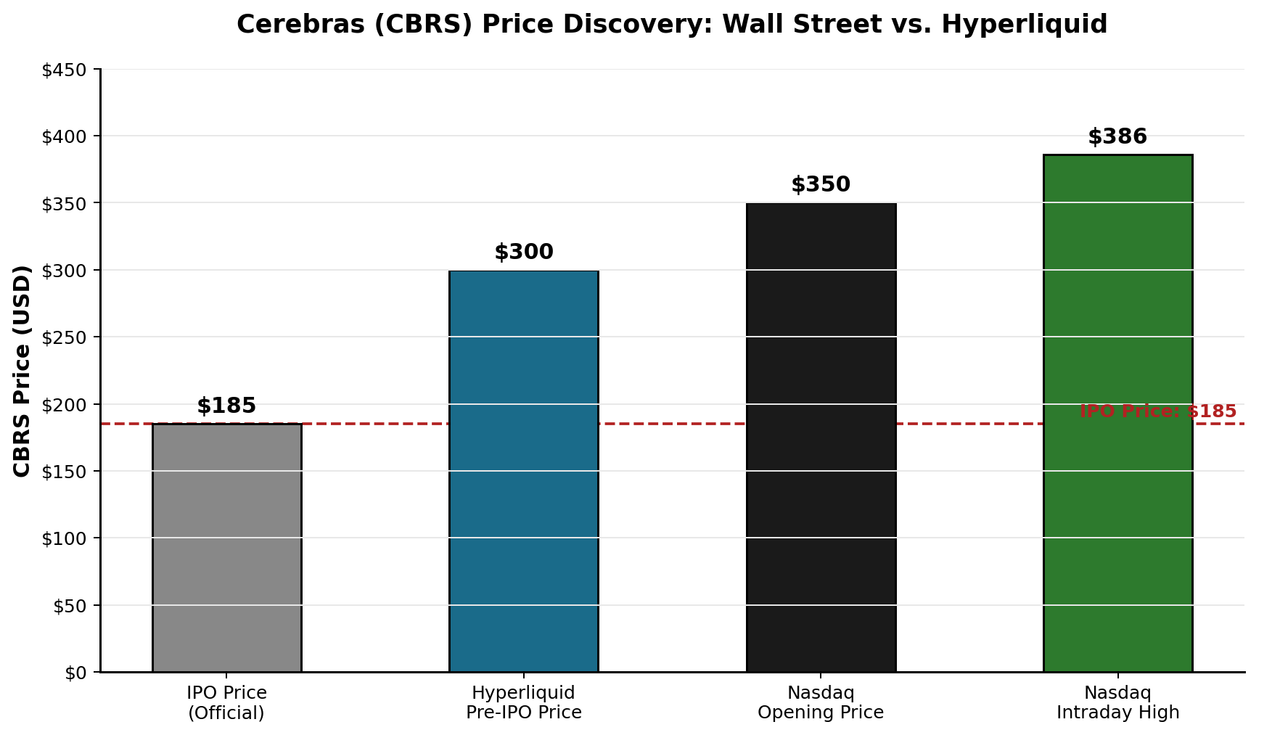
On May 15, 2026, the only credible hardware challenger to NVIDIA, an AI chip startup, Cerebras Systems (CBRS) officially went public. The company priced its 30 million Class A shares at $185, raising $6.4 billion and setting expectations for a strong debut.
But when the stock finally opened for continuous trading, it didn't open anywhere near $185. It opened at $350, an 89% premium, before surging to an intraday high of $386.
Wall Street was stunned. But traders on Hyperliquid weren't. They had already priced the stock at $300 hours before the opening bell rang.
The Pre-IPO Grey Market on Hyperliquid
Fourteen days before the Cerebras IPO, the Hyperliquid ecosystem launched the first-ever pre-IPO perpetual contract for CBRS.
This allowed retail traders, crypto funds, and institutional arbs to speculate on the future price of Cerebras long before the traditional syndicate roadshows had finalized their books.
In the weeks leading up to the IPO, the CBRS contract on Hyperliquid traded consistently in the $277 to $310 range. This implied a roughly 50% to 65% jump from the official $185 IPO price .
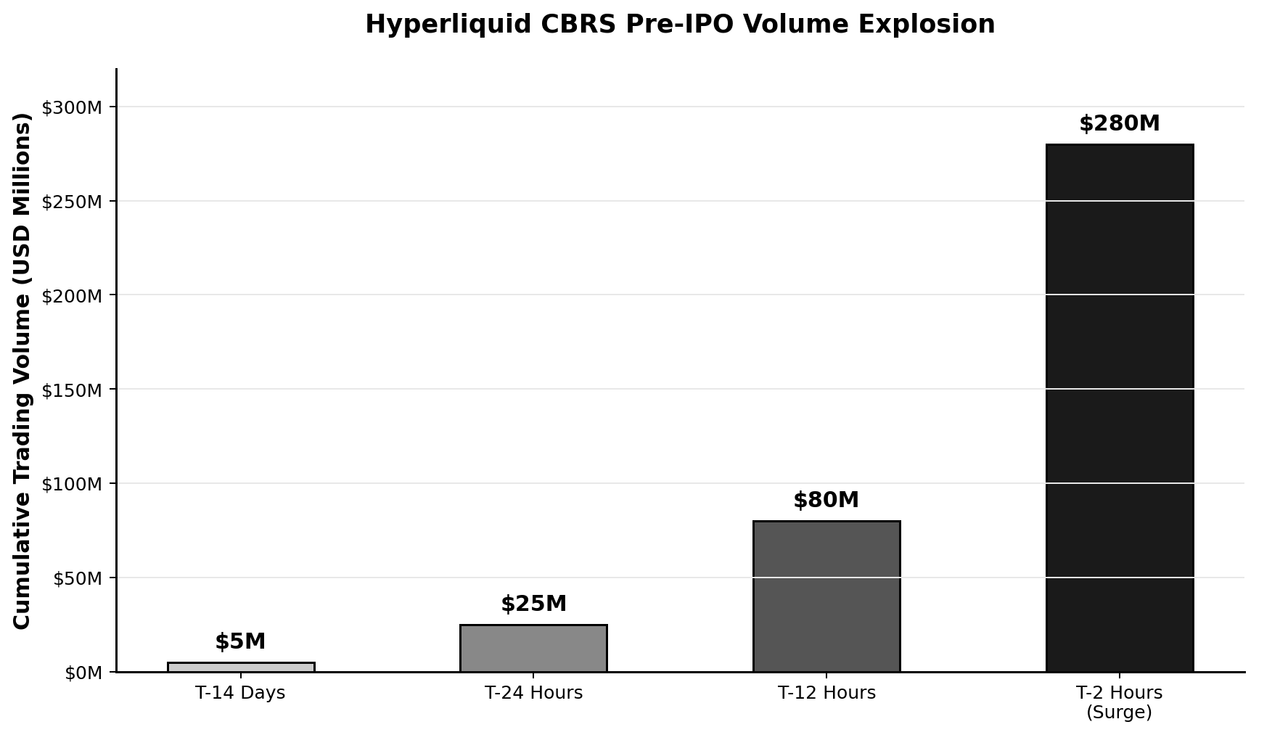
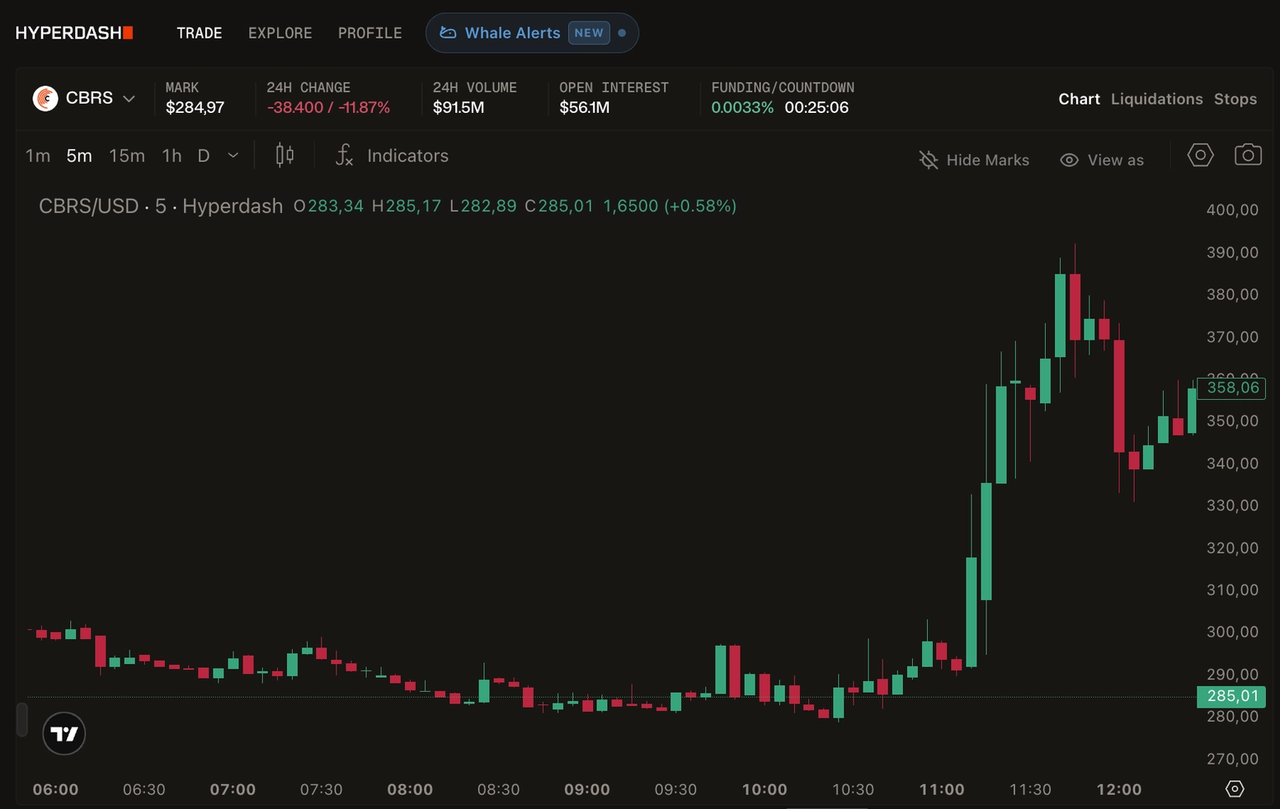
As the IPO approached, the volume exploded. Starting at 10 PM on May 14 (the night before the IPO), trading volume for CBRS contracts surged dramatically. The price rapidly pushed from the $290 range to $380. Within one hour, the contract's trading volume neared $100 million.
While CBRS shares on Nasdaq were still locked in the opaque, institutional-only matching and pricing phase, Hyperliquid traders were actively discovering the true market clearing price. By the time retail investors were allowed to buy the stock on Nasdaq at 1 AM, the CBRS contract on Hyperliquid had already amassed a 24-hour trading volume of $280 million.
Why TradFi is Terrified: The Asymmetric Threat
The accuracy of Hyperliquid's price discovery was a wake-up call for traditional finance. The on-chain market predicted the massive pop that traditional underwriters either missed or intentionally underpriced to reward their institutional clients.
This dynamic has not gone unnoticed by legacy venues. Reports surfaced the very same day that CME Group and the NYSE's parent company, Intercontinental Exchange (ICE), are pushing US regulators to tighten scrutiny of Hyperliquid.
The traditional exchanges cite concerns over market manipulation and sanctions exposure. But the real issue is structural competition. Hyperliquid enables continuous trading and real-time price discovery through perpetual contracts capabilities that are structurally impossible in the T+1, restricted-hours world of traditional equities.
Furthermore, Hyperliquid operates on a fundamentally different risk model. While CME and NYSE are neutral intermediaries that earn fees regardless of market direction, Hyperliquid routes liquidity through its internal vault, the Hyperliquidity Provider (HLP). The HLP acts as the counterparty to traders, meaning its performance is directly tied to trader outcomes. This highly efficient, capital-intensive model is eating into the derivatives volume that legacy exchanges view as their birthright.
The New Standard for Price Discovery
The Cerebras IPO will be remembered as a watershed moment. It proved that decentralized, can price traditional assets fastercan price traditional assets faster and more accurately than the legacy syndicate process. and more accurately than the legacy syndicate process.
As the lines between TradFi and DeFi continue to blur (evidenced by Coinbase becoming the official USDC treasury deployer on Hyperliquid the same week), the center of gravity for price discovery is shifting on-chain.
If you are still waiting for the 9:30 AM opening bell to tell you what an asset is worth, you are already hours behind the market.
This is exactly why we built Hyperdash. Hyperdash is the professional trading terminal designed specifically for the Hyperliquid ecosystem. It gives you the execution speed, advanced charting, and portfolio management tools you need to capitalize on these on-chain price discovery events before traditional markets even wake up. Trade CBRS on Hyperdash today and other 24/7 perpetuals.
Frequently Asked Questions (FAQ)
What was the Cerebras (CBRS) IPO price?
Cerebras priced its IPO at $185 per share. However, it opened for trading on Nasdaq at $350, an 89% premium.
How did Hyperliquid price CBRS before the IPO?
The Hyperliquid ecosystem launched pre-IPO perpetual contracts for CBRS 14 days before the official Nasdaq listing. Traders utilizing the Hyperliquid L1 priced the asset between $277 and $310, accurately predicting the massive IPO pop.
Why are CME and NYSE pushing for regulation of Hyperliquid?
Legacy exchanges are reportedly concerned about the rapid rise of decentralized derivatives platforms. While they cite market manipulation and compliance concerns, the underlying issue is that platforms like Hyperliquid are capturing significant derivatives volume and proving to be faster, more efficient venues for global price discovery.
Can retail investors trade pre-IPO assets?
In traditional finance, pre-IPO shares are typically reserved for institutional investors and high-net-worth individuals. However, decentralized platforms within the Hyperliquid ecosystem are beginning to offer pre-IPO perpetual contracts, allowing retail traders to participate in early price discovery.
What is the HLP (Hyperliquidity Provider) vault?
Unlike traditional exchanges that act as neutral matchmakers, Hyperliquid routes liquidity through the HLP vault. This vault provides liquidity, handles liquidations, and acts as the counterparty to traders on the platform.
Can I trade CBRS 24/7 on Hyperdash?
Yes. Unlike traditional stock exchanges that restrict trading to market hours, CBRS perpetual contracts on Hyperliquid are available 24 hours a day, 7 days a week, 365 days a year. Hyperdash is the professional trading terminal built specifically for the Hyperliquid ecosystem, giving you real-time charts, portfolio tracking, and execution tools to trade CBRS and hundreds of other assets at any hour, including during earnings events, pre-market surges, and weekend gaps.
Disclaimer: The information provided in this article is for educational and informational purposes only and should not be construed as financial or investment advice. Trading perpetual contracts, cryptocurrencies, and pre-IPO derivatives involves significant risk and may not be suitable for all investors. You should carefully consider your investment objectives, level of experience, and risk appetite before trading. Hyperdash does not provide investment advice, and past performance is not indicative of future results.