CoreWriter on Hyperliquid: What Builders Need to Know

July 23, 2025
By Hyperdash
Hyperliquid is a next-generation blockchain that promises the speed of centralized exchanges while ensuring users don't have to pay more than a few cents for every transaction. In this article, we will focus on Hyperliquid's CoreWriter update, which enables seamless interoperability between the HyperEVM and HyperCore layers.
Published
July 23, 2025
Author
Hyperdash
Reading time
3 min read
Category
Hyperliquid 101
What is CoreWriter on Hyperliquid?
The CoreWriter Hyperliquid update allows builders to submit transactions from HyperEVM to HyperCore. Any builder can submit these transactions to the CoreWriter contract and start writing new contracts to interact with the HyperCore layer.

How CoreWriter Works on Hyperliquid Blockchain
The CoreWriter contract is a system contract at address 0x3333333333333333333333333333333333333333 that enables users to send transactions from HyperEVM to HyperCore. To prevent any frontrunners actively monitoring the HyperEVM mempool, order actions and vault transfers submitted through the CoreWriter contract are delayed on-chain for a few seconds before they execute on HyperCore.
CoreWriter Transaction Format
Any transaction submitted through the CoreWriter contract needs to include the following details:
- Encoding Version: Currently, it sits at version 1 but future upgrades might have different version numbers with backward compatibility.
- Action ID: Unique identifier, encoded in three bytes, that points to different actions on HyperCore.
- Action Encoding: ABI encoding of the type and value that we are passing.
Why CoreWriter Matters for HyperEVM Adoption
Before CoreWriter, HyperEVM contracts could only read data from HyperCore, limiting builders to passive use cases like displaying prices or balances. With CoreWriter, builders can use smart contracts to directly write to HyperCore, enabling actions like placing limit orders, transferring spot assets, managing vaults. This transforms HyperEVM from a sidecar L1 into a programmable settlement layer tightly integrated with HyperCore’s liquidity and order books.
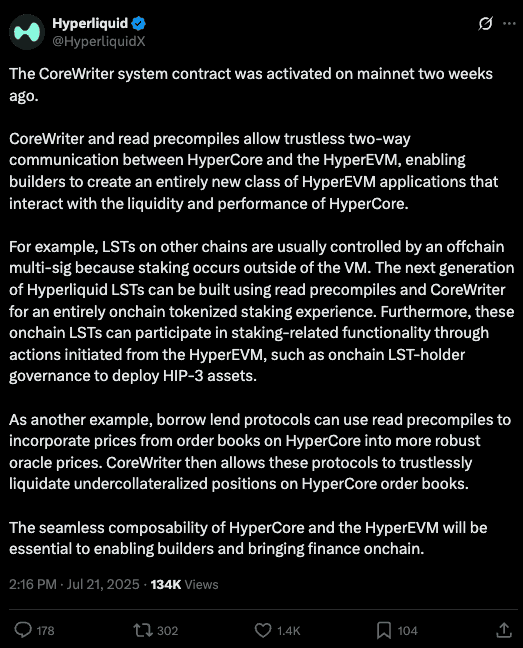
Many existing top protocols on HyperEVM are already in the race to launch new features by taking advantage of CoreWriter. Protocols like HyperLend, Felix, and Kinetiq have already begun integrating CoreWriter to launch new features.
Closing Thoughts: CoreWriter on Hyperliquid
The launch of CoreWriter on Hyperliquid has unleashed many possibilities for HyperEVM, making the layer more compatible with the HyperCore layer. By enabling smart contracts to submit actions that result in state changes on HyperCore, CoreWriter transforms HyperEVM into an active participant in the broader Hyperliquid stack and not just a passive sidechain.
FAQs
What can I do with CoreWriter?
You can use CoreWriter to place limit orders, transfer spot tokens, manage vaults, stake HYPE, and more. It allows HyperEVM contracts to actively change the state on HyperCore, not just read from it.
Is CoreWriter safe to use in production?
Yes. CoreWriter is a system contract deployed at a fixed address and maintained by the Hyperliquid core team. However, write operations are not atomic, meaning you cannot guarantee a result within the same transaction. This is intentional and helps prevent frontrunning.
How fast are CoreWriter transactions?
Order actions and vault transfers sent through CoreWriter are delayed by a few seconds after appearing onchain. This prevents latency advantages for actors monitoring the HyperEVM mempool and ensures fair execution timing. The delay is small enough that it does not affect UX for most applications.
Can I build cross-chain DeFi protocols using CoreWriter?
Absolutely. CoreWriter makes it possible to build DeFi protocols that span both HyperEVM and HyperCore. For example, a lending protocol on HyperEVM could automatically liquidate positions or rebalance exposure using real-time prices and orders on HyperCore.
Do I need permission to use CoreWriter?
No. CoreWriter is permissionless and available to any developer building on HyperEVM. You need to encode your action properly and submit it to the system contract address at 0x3333333333333333333333333333333333333333.