The Hidden Cost of Trading
October 20, 2026
By Hyperdash
At some point in every trader's career, they begin to reflect on their trading patterns and behaviors. One of the most important factors to overall success in trading is usually the most hidden: how much you spend on trading fees.
Typically traders only look at their profit and losses when analyzing their history, but it's also important to take a closer look at how much it costs you for every dollar of risk you are taking, especially when trading with leverage.
Published
October 20, 2026
Author
Hyperdash
Reading time
4 min read
Category
Tools & Data
Every trade you make pays a fee, and those fees add up. Most of that cost comes down to one choice you make on every order: whether you take liquidity from the book or make liquidity for it.
In this article, I'll show you how trading fees work and the order types that can help optimize your execution.
How Trading Fees Work
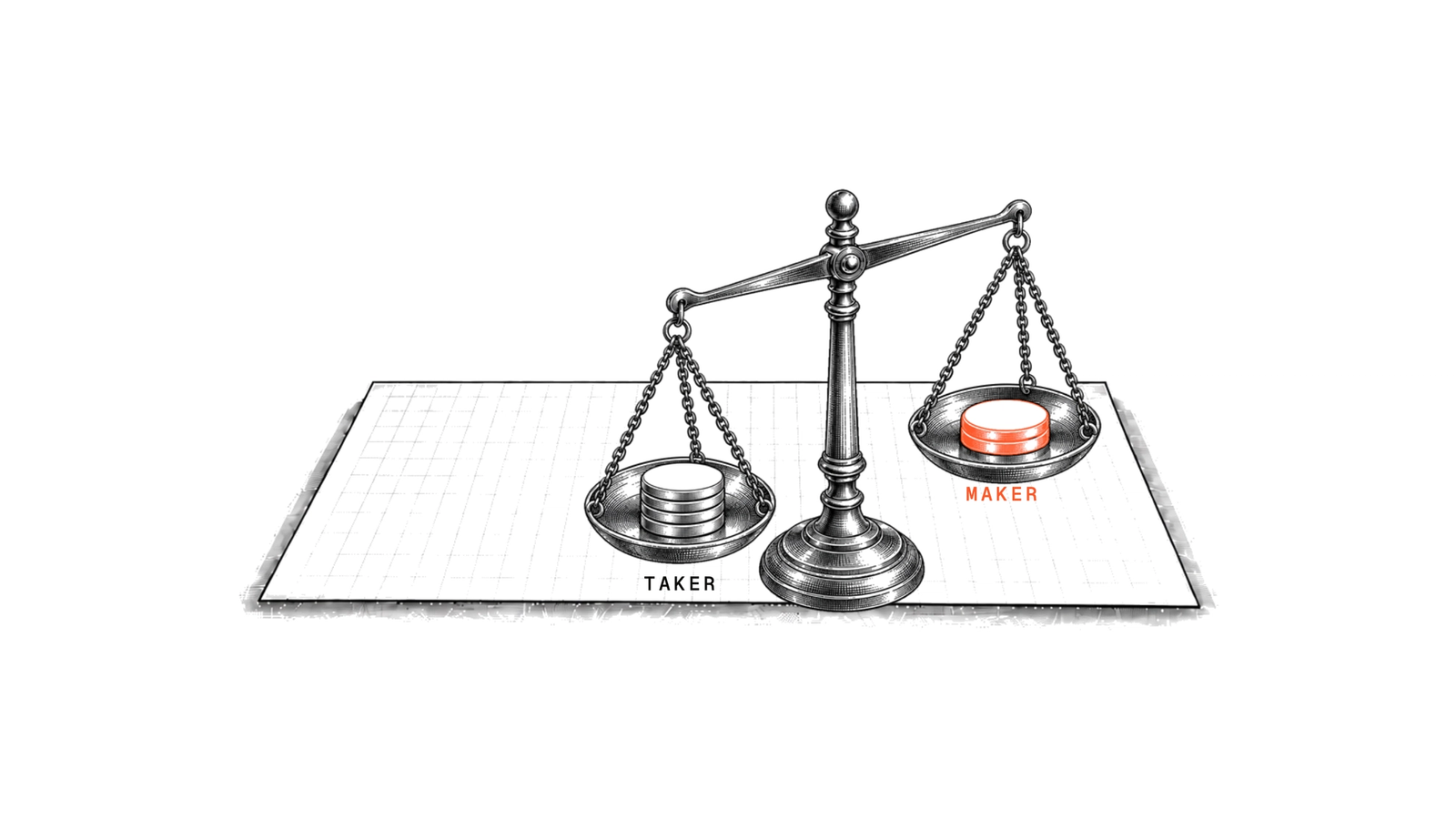
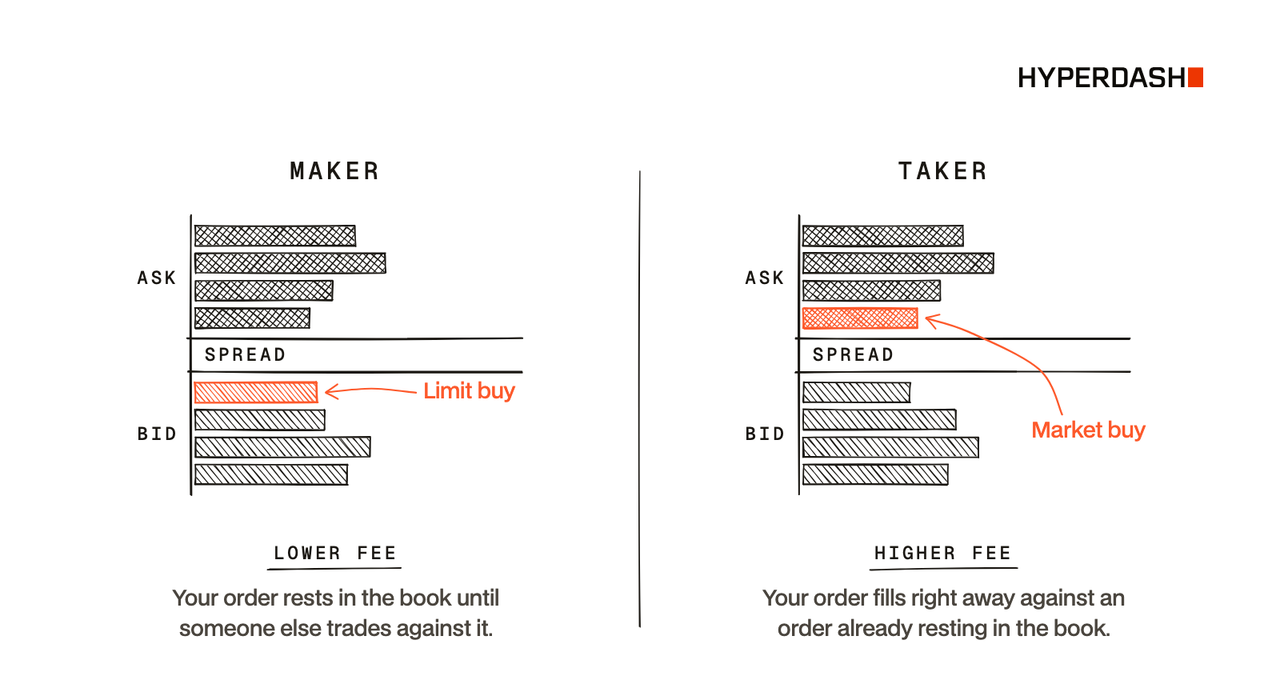
When your order fills against an order that was already resting in the book, you are the taker. Market orders are the most common example of this. You are willing to pay an extra fee to cross the spread and take liquidity that is resting on the current book.
When your order rests in the book and someone else trades against it, you are the maker. Limit orders are the most common example of this. As a maker, you are happy to wait for price to come to you and let others cross the spread into your resting liquidity. Many exchanges even offer maker rebates to traders who push large notional volumes, meaning they actually get paid to provide this resting liquidity in the order book.
Staying Passive with Maker Orders
The simplest way to pay the maker rate is a limit order below the current price on a buy or above it on a sell. It rests in the book until the market comes to you. Price it through the market and it fills straight away at the taker rate.
At Hyperdash, we have advanced algorithms purpose-built to optimize for makers fees, giving you more flexibility in how you approach the trade while still prioritizing cost savings.
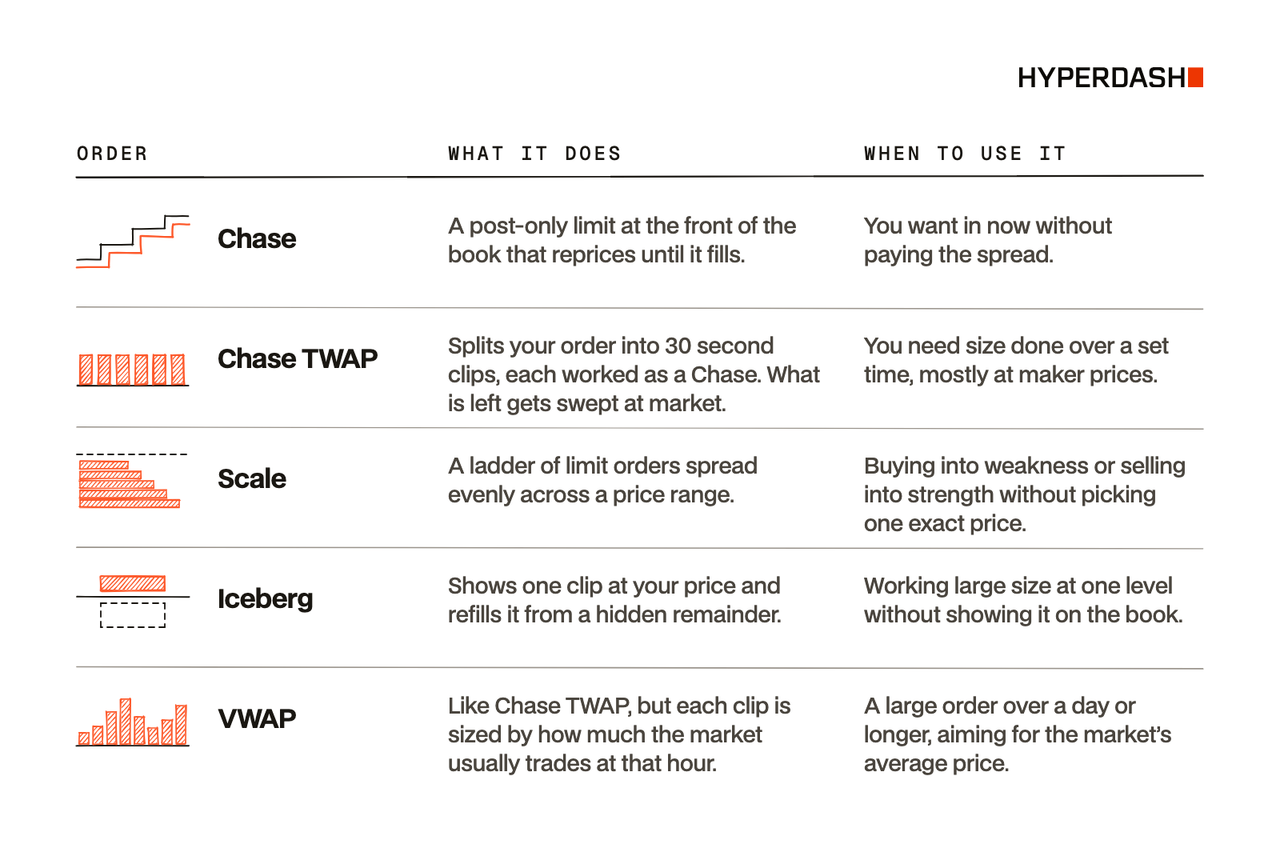
Chase: Best used when you want to enter a position now, ensure you are paying maker fees and you are willing to follow the market away from current price should it move. It places a post-only limit order at the best price you can get without crossing, one tick under the ask on a buy or one tick over the bid on a sell. On Hyperdash, our algo reprices every 500 milliseconds as the market moves. Because it is post-only, it can only fill as a maker.
Chase TWAP: Combines the cost savings of a chase order with the guaranteed nature of a TWAP. The algo works each slice as a passive chase order, sweeping any shortfall at market to ensure it finishes on schedule. During each clip, one post-only limit order chases the best bid (buys) or best ask (sells), working that clip’s outstanding target. It reprices about every 2 seconds as the top of book moves, rests passively, and never crosses the spread. This is best to use when you need to work size over time while optimizing for maker fills instead of paying the spread on every clip.
Scale: Select a start and end price, total number of orders and any size skew. This can be helpful when you want to build a position into weakness or sell into strength without picking one exact price, and it keeps a larger order from moving price with one big fill. As long as the whole range sits below the current price on a buy, or above it on a sell, each order rests in the book and fills as a maker.
Iceberg: Similar to a normal limit order, this algo lets you work the trade at a fixed price level in the book. What's different is your full size is never shown, only smaller clips that are refreshed once filled. You set your size and the number of clips, and only one clip sits in the book at a time. When it fills, the next one goes out at the same price, and Randomize varies the clip sizes. I use it when I want to work a larger order at one level without showing the whole size.
VWAP: Like our Chase TWAP algo, VWAP (Volume Weighted Average Price) works your order over a duration you set but paces it by how much the market usually trades at each time of day: more in busy hours, less in quiet hours and on weekends. The objective is to put more of your size into the hours when the market is busiest, reducing your impact and improving execution.
The Hidden Cost of Your Order Type
Previously we shared our analysis of over 400,000 retail traders across 6 mobile apps. Since November 10th, 2025, they have lost $126M through these apps, and over half of that, $66.8M, went to fees. When we split those fees by how each order was filled, 97% were paid as taker. Almost all of their volume crossed the spread, paying the higher fee on nearly every trade.
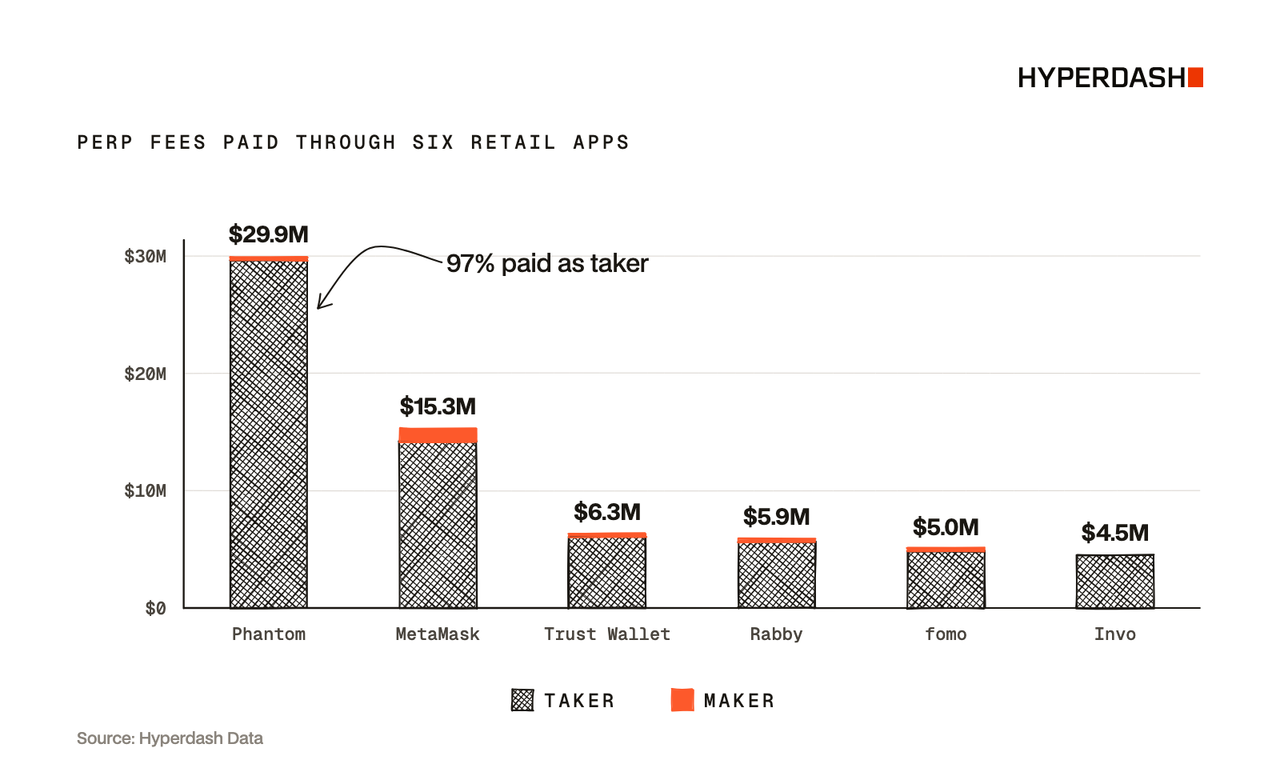
For most traders, the hidden cost of trading comes down to the order type they use. Our advanced execution algos at Hyperdash are built to keep you on the maker side while still getting your trade done.
Trade smarter with Hyperdash today.