Binance Just Hit the MiCA Wall. Here is What EU Traders Need to Do Next.
June 29, 2026
By Hyperdash
The countdown is over, and the outcome is not what the market expected. For months, European cryptocurrency traders assumed that Binance, the world's largest exchange by volume, would seamlessly navigate the European Union's Markets in Crypto-Assets (MiCA) regulatory framework. That assumption was wrong.
Published
June 29, 2026
Author
Hyperdash
Reading time
6 min read
Category
DeFi & Crypto Fundamentals
As the July 1, 2026 deadline arrives, Binance enters the new regulatory era without a Crypto-Asset Service Provider (CASP) authorization. The exchange has formally withdrawn its licensing application in Greece, reportedly following behind-the-scenes intervention from the European Central Bank, and has begun notifying EU users of impending service restrictions.
For retail investors who buy and hold spot Bitcoin, this is an inconvenience. But for active traders who rely on deep liquidity, high-leverage perpetuals, and stablecoin collateral, this is a structural break in how they access the market.
If you are an EU-based trader with capital on Binance, the grace period is over. Here is exactly what is happening, what you stand to lose on a fully licensed centralized exchange, and how to migrate your trading infrastructure to a non-custodial alternative.
The Reality of Binance's MiCA Withdrawal
Binance officially withdrew its MiCA CASP license application from the Hellenic Capital Market Commission in Greece on June 21, 2026. Consequently, as the MiCA transitional period expires on July 1, 2026, Binance lacks the legal authorization required to actively serve or solicit clients within the 30-nation European Economic Area.
The collapse of Binance's European licensing strategy happened quickly. The exchange had initially filed its application through a newly created Greek subsidiary in January 2026. By June, reports surfaced that the application was facing imminent rejection. Rather than face a formal denial on the public record, Binance pulled the application entirely.
While the exchange stated it remains confident it can secure a license "in the coming months" in another member state, the immediate reality for users is stark. The July 1 deadline has no extensions. Without a CASP license, Binance cannot legally operate a trading platform or solicit users across the EU.
In response, Binance has begun adjusting its service offerings to remain compliant. For EU users, this means navigating a fractured platform where certain products, tokens, and leverage levels may be abruptly restricted or geoblocked. The era of unrestricted, borderless trading on Binance has effectively ended for European residents.
What MiCA-Compliant Exchanges Actually Mean for Active Traders
As of late June 2026, only approximately 14 entities hold specific authorization to operate a crypto trading platform under MiCA, representing less than 1% of the thousands of virtual asset service providers that operated prior to the regulation.
For traders displaced by Binance's restrictions, and are thinking the natural next step is to migrate to one of the few centralized exchanges that successfully secured a MiCA license, just because these platforms offer regulatory clarity and operational continuity, are realizing that MiCA compliance also introduces a set of structural constraints that directly affect the trading experience, and active traders should understand exactly what changes before moving capital.
Migrating to a fully MiCA-compliant centralized exchange means accepting three fundamental constraints:
- The End of USDT Collateral Tether (USDT) is the lifeblood of crypto derivatives trading, but it is not authorized under MiCA. Major regulated venues, including Kraken, Crypto.com, and Coinbase, delisted USDT for EEA retail users months ahead of the deadline. If you trade on a licensed EU platform, you must convert your capital to a compliant stablecoin like EURC, fracturing your liquidity and forcing unwanted currency conversions.
- Severe Leverage Restrictions MiCA itself does not regulate perpetual futures, those fall under the broader MiFID II financial regulations. To legally offer leveraged derivatives to EU retail clients, an exchange must hold both a MiCA CASP license and a MiFID II authorization. Very few do. Those that do are subject to strict retail leverage caps, often limiting traders to 2x or 5x leverage, fundamentally breaking strategies built for 20x or 50x.
- Narrower Asset Selection Compliance requires rigorous asset vetting. Licensed exchanges are rapidly delisting long-tail altcoins and smaller market-cap tokens that cannot meet MiCA's strict whitepaper and disclosure requirements. The vibrant, permissionless market of newly launched tokens is largely inaccessible on compliant centralized venues.
The Hyperdash Architectural Difference
Under MiCA Article 3, the regulation explicitly focuses on centralized entities that provide custodial and trading services to third parties on a professional basis. Non-custodial trading interfaces operate on a fundamentally different architecture, allowing users to trade directly from self-hosted wallets without transferring custody to an intermediary.
To navigate the evolving landscape of centralized exchange operations, active traders are increasingly adopting non-custodial trading platforms. This is where Hyperdash provides a critical alternative.
Because Hyperdash does not take custody of your funds or act as a centralized broker, its operational model differs entirely from traditional exchanges like Binance. When you connect to Hyperdash, you are not depositing funds into a corporate wallet; you are interacting directly with an on-chain protocol.
This architectural distinction provides a consistent, high-performance trading environment for users connecting from their own wallets. By migrating your trading volume to Hyperdash, you access:
- Consistent Market Access: Trade 24/7 directly from your self-hosted wallet.
- Flexible Leverage: Utilize up to 50x leverage on major crypto assets, maintaining the capital efficiency you require.
- Deep Market Breadth: Access over 230 perpetual markets, including BTC, ETH, SOL, and tokenized equities like NVDA, TSLA, and SPCX.
Hyperdash delivers the speed, liquidity, and user experience of a top-tier centralized exchange while preserving the foundational self-sovereignty of decentralized finance.
How to Migrate from Binance to Hyperdash
Hyperdash supports direct deposits from Binance. Using the "Deposit from Exchanges" feature, you can transfer your capital directly from your at-risk exchange to your Hyperdash account, without converting to fiat, without waiting for a bank transfer, and without losing exposure to the markets you are trading.
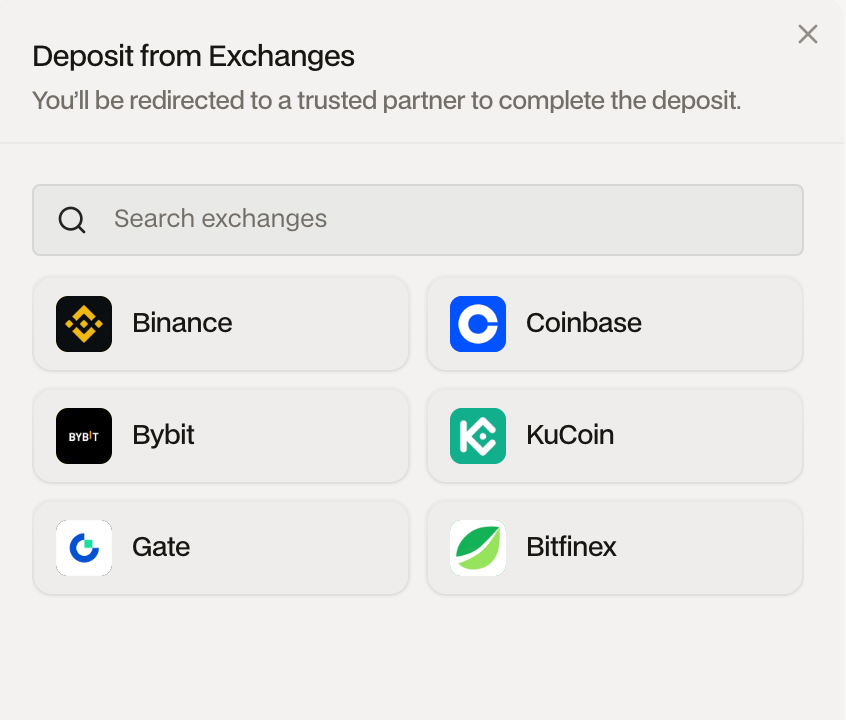
Here is the step-by-step process:
- Create an account on Hyperdash at hyperdash.com.
- Click "Deposit" in the top navigation bar and select "Deposit from Exchanges" from the dropdown.
- Select the Binance exchange from the list.
- You will be redirected to our trusted partner to complete the direct transfer. The process is guided and takes approximately 5–10 minutes.
- Your funds arrive in your Hyperdash account, ready to trade.
There is no need to sell your positions to fiat first. There is no bank transfer involved. Your capital moves directly from one trading environment to another.
The regulatory landscape in Europe has changed permanently. Do not wait for centralized exchanges to dictate how and what you can trade. Take custody of your capital and upgrade your infrastructure today.
Frequently Asked Questions (FAQ)
Why is Binance restricting EU users?
Binance withdrew its application for a MiCA CASP license in Greece and currently lacks the authorization required to legally operate a trading platform or solicit users across the 30-nation European Economic Area after the July 1, 2026 deadline.
Can I still use USDT on licensed European exchanges?
No. Tether (USDT) has not sought authorization under MiCA. Major licensed exchanges in the EU have already delisted USDT for retail users, requiring them to convert to compliant alternatives like USDC or EURC.
How does Hyperdash differ from Binance?
Binance is a centralized custodian that holds your assets and executes trades on your behalf. Hyperdash is a non-custodial trading terminal where you connect your own wallet, retain full control of your private keys, and trade directly via on-chain smart contracts.
Disclaimer
This article is for informational and educational purposes only. It does not constitute financial advice, legal advice, or a recommendation regarding any specific crypto platform or asset. Cryptocurrency investments carry significant risk including total loss of capital.