The MiCA Deadline: Which Exchanges Are Out and What Happens to Your Account

June 23, 2026
By Hyperdash
On July 1, 2026, the European Union's Markets in Crypto-Assets Regulation (MiCA) closes its 18-month transition window. After that date, any crypto exchange that has not obtained a full Crypto-Asset Service Provider (CASP) authorization from an EU national regulator is legally prohibited from serving EU residents. No grace period. No extensions. No grandfather clause.
Published
June 23, 2026
Author
Hyperdash
Reading time
17 min read
Category
DeFi & Crypto Fundamentals
The scale of what is about to happen is significant. According to the CEO of OKX Europe, approximately 80% of crypto firms operating in the EU today do not hold a valid CASP license. A separate estimate from industry analysts suggests that 60% of European crypto users are currently active on platforms that are not authorized under MiCA. That is tens of millions of accounts on platforms that may, within days, be required to restrict access, freeze new deposits, or initiate mandatory wind-down procedures.
If you are trading on Binance, Bybit, KuCoin, Gate.io, or MEXC, your account is at risk. This article covers everything you need to know: which exchanges are at risk, what the enforcement mechanism looks like, what happens to your funds on July 2, why USDT creates an additional complication even on licensed platforms, and why on-chain perpetual futures are the only trading alternative that is structurally immune to MiCA enforcement.
MiCA is the first comprehensive regulatory framework for crypto-assets in the European Union. It establishes uniform rules for the issuance and trading of crypto-assets, requires all crypto-asset service providers to obtain authorization from a national competent authority in an EU member state, and creates a passporting mechanism that allows a single authorization to cover all 27 EU member states and the broader EEA. The transition period under Article 143(3) of MiCA allowed entities operating under legacy national registrations to continue doing so until July 1, 2026. After that date, only entities holding full CASP authorization may legally provide crypto-asset services to EU residents.
What Is MiCA and Why Does July 1 Matter?
MiCA is the EU's first comprehensive regulatory framework for crypto-asset service providers. It was published in the Official Journal of the European Union in June 2023 and has been phased in over two years. The final and most consequential phase, the authorization requirement for CASPs, became enforceable on December 30, 2024, with an 18-month transition period allowing existing platforms to continue operating while they applied for licenses.
That transition period ends on July 1, 2026.
After that date, operating as a CASP in the EU without authorization is a criminal offense in several member states. France's Autorité des marchés financiers (AMF), for example, can impose fines of up to EUR 30,000 and prison sentences of up to two years for unlicensed crypto service provision. Germany's BaFin can issue cease-and-desist orders and refer cases to prosecutors. National regulators across the EU have the authority to instruct internet service providers to block access to unauthorized platforms at the domain level.
The regulation covers a broad range of services: operating a trading platform, providing custody of crypto assets, executing orders on behalf of clients, and providing exchange services between crypto assets and fiat currencies. Any platform doing any of these things for EU residents without a CASP license is in violation of MiCA after July 1.
After July 1, 2026, any entity without full CASP authorization is prohibited from providing crypto-asset services to EU residents under MiCA Article 59. National competent authorities have the power to issue public warnings, order cessation of services, impose administrative fines of up to EUR 700,000 for legal persons, and refer cases for criminal prosecution. The ESMA interim register is the authoritative source for determining which platforms hold valid authorization.
The At-Risk List: Which Exchanges Are Not MiCA Compliant?
Binance presents the most complex and consequential situation. The exchange secured a CASP authorization in 2025 through an EU entity re-domiciling, and its passport was reported as covering all 27 member states. However, Reuters reported on June 16, 2026 that Greece's Hellenic Capital Market Commission (HCMC) was set to reject Binance's MiCA license application. Since a CASP passport requires an initial authorization from a single member state, a rejection in Greece, if not remedied by authorization in another jurisdiction, could leave Binance's EU passporting rights in a legally ambiguous state heading into July 1. With an estimated 40 million EU users, this is the single largest exposure in the market. As of the publication date of this article, Binance has not confirmed its regulatory status for EU users.
MEXC has already acted. The exchange issued an official communication in June 2026 advising EU users to withdraw their funds before July 1, citing MiCA compliance requirements. This is the clearest signal yet of what is coming: platforms that cannot obtain authorization are beginning to exit the EU market proactively.
Bybit, KuCoin, Gate.io, Bitget, HTX, BingX, Phemex, CoinEx, and BloFin do not appear on the ESMA interim CASP register as of June 23, 2026. Their combined EU user base is estimated at over 25 million accounts. None of these exchanges have issued public statements confirming their MiCA compliance path
MEXC issued an official notice in June 2026 advising EU users to complete all withdrawals before July 1, 2026, citing MiCA compliance requirements. The notice stated that MEXC would be restricting services for EU residents following the end of the transition period. This represents the first major offshore exchange to formally signal a market exit ahead of the deadline.
The USDT Problem: Why Even Licensed Exchanges Are Complicated
There is a second layer to the MiCA compliance picture that affects even users on fully licensed exchanges: stablecoin restrictions. MiCA classifies stablecoins as either asset-referenced tokens (ARTs) or e-money tokens (EMTs), and requires their issuers to obtain specific authorization from an EU regulator before the token can be legally traded on a CASP platform.
Tether (USDT), the world's largest stablecoin by market capitalization and the primary trading pair on most crypto exchanges, has not obtained EMT authorization under MiCA. Tether has publicly stated that it has no current intention to pursue MiCA authorization. As a result, USDT trading has been restricted or delisted on several licensed CASPs. Kraken, Coinbase, and Bitstamp have all restricted USDT trading for EU users to varying degrees. Some platforms allow USDT custody but prohibit buying or selling it on the order book. Others have removed USDT pairs entirely.
The practical consequence for active traders is significant. If you move from an unlicensed exchange to a licensed one, you may find that your primary trading pair (USDT) is unavailable or restricted. The MiCA-compliant alternatives are Circle's USDC and Société Générale's EURCV, both of which hold EMT authorization. However, USDC has significantly lower liquidity than USDT on most pairs, and EURCV is not yet widely supported across exchanges.
For traders who rely on USDT as a base currency, this creates a genuine operational problem that moving to a licensed CEX does not solve. The stablecoin that underpins most of your trading activity may not be available on the compliant platform you migrate to.
USDT, DAI, USDe, FDUSD, PYUSD, and TUSD all lack MiCA authorization as of June 2026. Tether has stated no intention to pursue MiCA authorization. USDC (Circle) and EURCV (Société Générale) are the primary MiCA-compliant stablecoins available to EU traders. Several major licensed exchanges have restricted or delisted USDT trading for EU users as a result.
The Stablecoin Complication
MiCA does not just affect exchanges. It also directly restricts which stablecoins can be used within the EU. To be legally offered to EU residents, a stablecoin must be issued by an entity that holds the appropriate MiCA authorization.
As of June 2026, the following major stablecoins are not MiCA-authorized and face restrictions on EU platforms:
- USDT (Tether) — not authorized as an EMT, already delisted from several EU-licensed exchanges;
- DAI — not authorized, as its decentralized issuance model does not fit the
MiCA EMT framework; - USDe (Ethena) — not authorized;
- FDUSD (First Digital) — not authorized;
- PYUSD (PayPal) — not authorized for EU distribution;
- TUSD — not authorized.
The practical consequence: even if you move to a licensed EU exchange, you may not be able to hold or trade with USDT, the dominant stablecoin in crypto derivatives markets. The MiCA-compliant alternatives are USDC (Circle, authorized as an EMT) and EURC (Circle's euro-denominated stablecoin). Some platforms also accept EURCV (Société Générale's euro stablecoin).
This creates a significant friction point for traders who are used to holding the banned stablecoins as their base currency. Moving to a licensed CEX means not just changing platforms, it means changing your entire stablecoin stack.
On-chain perpetuals platforms, by contrast, allow users to maintain full control over their own wallets and choose their own collateral. The MiCA stablecoin restrictions apply to centralized custodians offering stablecoins to EU residents, not to individual users managing their own on-chain positions.
Under MiCA Title III and Title IV, stablecoins issued by entities without EMT or ART authorization cannot be publicly offered or admitted to trading on regulated platforms in the EU. USDT, the dominant stablecoin in global crypto derivatives markets, is not authorized under MiCA. Circle's USDC holds EMT authorization, as does Circle's EURC. Traders relying on USDT as base collateral on licensed EU exchanges will need to convert to MiCA-compliant alternatives.
What Happens on July 2? The Enforcement Mechanics
The practical outcome for users on non-compliant exchanges depends on how each platform responds to the deadline. Based on what is confirmed versus what is precedent-based inference, here is what you should realistically expect.
The most likely and confirmed outcome is a wind-down sequence. This is the model MEXC has already announced and the same model Binance used when it exited Germany and the Netherlands in 2021: new deposits are restricted first, then new order placement, then the platform enters a withdrawal-only mode. You will be able to recover your funds, but you will not be able to continue trading. The timeline for each phase varies by exchange and by how quickly the relevant national regulator moves.
A more disruptive but less certain outcome is immediate service cessation, where the exchange halts all services for EU residents at once, with accounts moved to a read-only state pending withdrawal processing. This has occurred in other jurisdictions under different regulatory frameworks (notably Binance's exit from Ontario, Canada in 2021), but there is no confirmed precedent under MiCA enforcement specifically. Whether individual EU member states will push for this approach after July 1 is not yet known.
ISP blocking is a power that MiCA explicitly grants to national competent authorities under Article 94. Whether and how quickly individual member states will exercise it after July 1 is not confirmed. It is a tool available to regulators, not a guaranteed outcome. If it is applied, users who have not already withdrawn their funds may find the platform inaccessible without a VPN.
The common thread across all scenarios is the same: the earlier you move your funds, the more control you retain over the process. Waiting until July 1 means you are operating on the exchange's timeline, not your own.
Based on precedent from prior exchange exits, platforms typically move through a wind-down sequence: first restricting new deposits, then restricting new positions, then entering a withdrawal-only mode. The duration of each phase varies by jurisdiction and by the exchange's relationship with the relevant national competent authority. Users who have not migrated their funds before the deadline face the risk of delayed access during the wind-down period.
Why Moving to a Licensed CEX Is Not the Answer
The obvious question is: why not just move to a MiCA-licensed exchange? Coinbase, Kraken, and OKX are all licensed. They are reputable. They are not going anywhere.
The answer is that the product you are moving to is fundamentally different from the product you are leaving.
Licensed EU exchanges operate under MiCA's leverage caps: a maximum of 2x leverage for retail clients on crypto derivatives. If you are currently trading with 10x, 20x, or 50x leverage on Binance or Bybit, that option disappears entirely on a licensed EU platform.
Token selection is also significantly restricted. Licensed EU exchanges cannot list tokens that do not meet MiCA's disclosure requirements. Many of the altcoins, memecoins, and emerging assets that generate the most trading volume on offshore platforms are not available on licensed EU exchanges.
And as discussed above, USDT, the standard collateral for derivatives trading, is not available on most licensed EU platforms. You would need to convert your entire position to USDC or EUR-denominated collateral.
For a spot trader who holds BTC and ETH and trades occasionally, a licensed EU exchange is a reasonable option. For a derivatives trader who uses leverage, trades a broad range of assets, and manages positions in USDT, a licensed EU exchange is not a viable replacement.
MiCA Article 79 imposes leverage limits on crypto-asset service providers offering leveraged trading to retail clients in the EU. The maximum leverage for retail clients on crypto derivatives is 2:1 for major crypto assets and lower for others. This represents a significant reduction from the leverage levels available on offshore platforms, which commonly offer 10x to 100x leverage on perpetual futures contracts.
Exchange-by-Exchange Breakdown: What EU Users Should Do Right Now
The following section addresses the specific situation for users of each major at-risk exchange, based on publicly available information as of June 23, 2026.
Binance
Binance is the most consequential case. The exchange has an estimated 40 million users in Europe, by far the largest EU user base of any crypto platform. Binance secured a CASP authorization in 2025 and announced EU passporting. However, Reuters reported on June 16 that Greece's HCMC was set to reject the license, which would put the passporting arrangement in legal jeopardy. Binance has stated it will provide an update before July 1. EU Binance users should monitor official announcements closely and prepare a contingency plan for withdrawal.
MEXC
MEXC does not appear on the ESMA CASP register as of June 23, 2026. The exchange has not announced a CASP authorization timeline for EU users. MEXC's own news channel has published articles acknowledging the MiCA deadline risk. EU users should treat their MEXC accounts as at high risk of access restriction after July 1 and initiate withdrawal of funds immediately.
Bitget
Bitget does not appear on the ESMA CASP register. The exchange has a significant EU user base and offers a broad range of perpetual futures products. No CASP authorization has been announced. EU users face the same risk profile as MEXC users.
Gate.io
Gate.io has secured a CASP authorization through Malta's MFSA, according to the Paybis MiCA exchange list published June 18, 2026. This places Gate.io in a different category from MEXC and Bitget, it has a pathway to continued EU operations. However, EU users should verify this status independently on the ESMA register before July 1.
HTX, BingX, Phemex, CoinEx, LBank, BitMart, BloFin
None of these exchanges appear on the ESMA CASP register as of June 23, 2026. All carry a critical risk rating for EU users. Withdrawal of funds before July 1 is strongly recommended for users on any of these platforms.
The Action Plan: What to Do Before July 1
If you are an EU resident currently using any of the at-risk exchanges listed above, the following four-step action plan applies regardless of which platform you are on.
- Verify your exchange's status on the ESMA register. Go to esma.europa.eu and download the current CASP authorization CSV. Search for your exchange by name. If it does not appear, treat your account as at risk.
- Withdraw your funds before July 1. Do not wait for an official announcement from the exchange. Exchanges that enter wind-down mode may impose withdrawal queues or daily limits. Moving your assets now, while the platform is fully operational, eliminates that risk.
- Decide where to move. If you primarily use your exchange for spot trading and fiat on/off ramps, a licensed CEX is the straightforward answer. If you primarily use perpetual futures with leverage, a licensed CEX will not replicate the product set you are accustomed to. On-chain perps via Hyperdash offer the same asset breadth, the same leverage, and no geographic restriction.
- Stablecoin situation. If you hold USDT on a licensed CEX, check whether that platform restricts USDT trading for EU users. If it does, you may need to convert to USDC or EURCV before trading. On-chain perps on Hyperdash use USDC as the primary collateral asset, which is MiCA-compliant.
The window to act is narrow. July 1 is days away. The exchanges that are at risk have not committed to a compliance timeline, and the regulatory enforcement mechanism is now fully operational. The traders who move first will avoid the queues, the frozen accounts, and the forced wind-downs that are likely to follow.
Trading Without Borders: The On-Chain Alternative
Hyperdash is a professional-grade trading terminal built on on-chain perpetuals protocol. It provides access to over 230 markets, including crypto, equities (e.g. NVDA, TSLA, SPCX), and commodities, and more, with leverage, 24/7 trading, and full self-custody.
For EU traders who are migrating away from unlicensed exchanges, Hyperdash offers the closest equivalent to the product set they are leaving behind, without the regulatory risk that comes with it. Sign up with your wallet or email, deposit funds from anywhere, and start trading. The protocol does not care where you are located.
How to Move Your Funds Directly to Hyperdash
Hyperdash supports direct deposits from six of the exchanges most affected by the MiCA deadline: Binance, Bybit, KuCoin, Gate, Coinbase, and Bitfinex. Using the "Deposit from Exchanges" feature, you can transfer your capital directly from your at-risk exchange to your Hyperdash account, without converting to fiat, without waiting for a bank transfer, and without losing exposure to the markets you are trading.
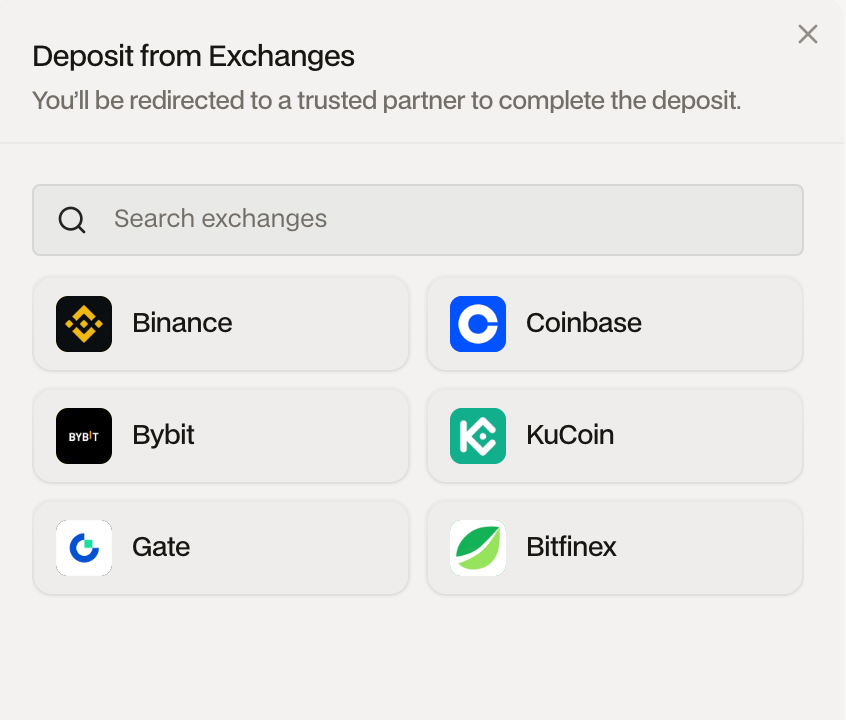
Here is the step-by-step process:
- Create an account on Hyperdash at hyperdash.com.
- Click "Deposit" in the top navigation bar and select "Deposit from Exchanges" from the dropdown.
- Select your current exchange from the list. Supported exchanges include Binance, Bybit, KuCoin, Gate, Coinbase, and Bitfinex.
- You will be redirected to our trusted partner to complete the direct transfer. The process is guided and takes approximately 5–10 minutes.
- Your funds arrive in your Hyperdash account, ready to trade.
There is no need to sell your positions to fiat first. There is no bank transfer involved. Your capital moves directly from one trading environment to another.
Hyperdash's "Deposit from Exchanges" feature enables direct capital migration from major centralized exchanges, including Binance, Bybit, KuCoin, Gate, Coinbase, and Bitfinex, to auser's Hyperdash trading account. The process is completed via a trusted third-party partner and does not require conversion to fiat currency. Users retain full self-custody of their funds throughout the process.
The Asset Universe You Are Gaining Access To
One of the most significant differences between Hyperdash and a licensed EU exchange is the breadth of tradeable assets.
On Hyperdash, you can tradeperpetual futureson over 230 assets, including crypto majors and altcoins (BTC, ETH, SOL, AVAX, LINK, and hundreds of others), tokenized equities (NVDA, TSLA, AAPL, MSFT, AMZN, META, GOOGL, SpaceX, available 24 hours a day, 7 days aweek, with no earnings blackouts, no market hours, and no geographic restrictions), and commodities including gold, silver and oil.
This asset universe is not available on any MiCA-licensed EU exchange. It is only available on-chain, where the protocol does not discriminate between asset classes or trading hours.
For traders who are currently using offshore exchanges precisely because they want access to this breadth of markets, Hyperdash is not a compromise, it is an upgrade
Frequently Asked Questions (FAQ)
Is Binance banned in Europe after July 1, 2026?
Binance's EU status is uncertain as of June 23, 2026. The exchange secured a CASP authorization in 2025, but Reuters reported on June 16 that Greece's HCMC was set to reject the license, which could affect its EU passporting rights. Binance has stated it will provide an update before July 1. EU users should monitor official announcements and prepare contingency plans.
Is MEXC legal in Europe after July 1, 2026?
MEXC does not appear on the ESMA CASP register as of June 23, 2026. Without a CASP authorization, MEXC cannot legally provide crypto-asset services to EU residents after July 1. EU users should withdraw funds before the deadline.
Is USDT banned in Europe under MiCA?
USDT is not banned outright, but Tether has not obtained the e-money token (EMT) authorization required under MiCA. As a result, several licensed exchanges have restricted or delisted USDT trading for EU users. USDC and EURCV are the primary MiCA-compliant stablecoin alternatives.
Are decentralized exchanges and on-chain protocols affected by MiCA?
On-chain protocols that do not custody user funds and do not operate as legal entities in EU member states are generally not classified as crypto-asset service providers under MiCA.
How do I check if my exchange is MiCA compliant?
The authoritative source is the ESMA interim CASP register, available at esma.europa.eu. Download the CSV file of authorized crypto-asset service providers and search for your exchange by name. If it does not appear, it does not hold a current CASP authorization.
Will I lose my funds if my exchange is banned?
In most cases, no. Exchanges that exit the EU market typically move to a withdrawal-only mode, allowing users to recover their funds. However, the process can take days or weeks, and in some cases ISP blocking can make it difficult to access the platform. The safest approach is to migrate before the deadline.
Is Binance definitely banned in Europe?
As of June 23, 2026, Binance does not hold a valid CASP license in any EU member state. Reuters reported that its license application in Greece was set to be rejected. Without a CASP license, Binance cannot legally serve EU residents after July 1. Binance has not confirmed its regulatory status for EU users.
What happens to my open positions if my exchange goes into wind-down mode?
Most exchanges in wind-down mode allow existing positions to be closed but do not allow new positions to be opened. You should close your positions and withdraw your funds as quickly as possible. Do not wait for the exchange to force-close your positions, as this may result in unfavorable execution prices.
Disclaimer
This article is provided for informational purposes only and does not constitute legal, financial, or regulatory advice. The MiCA compliance status of exchanges listed in this article is based on publicly available information as of June 23, 2026, and may change before or after the July 1 deadline. EU residents should consult a qualified legal or financial advisor before making decisions about their crypto holdings. Trading perpetual futures involves significant risk of loss, including the potential loss of the entire amount invested. Leverage amplifies both gains and losses. Only trade with capital you can afford to lose.