How To Trade The Strait of Hormuz 24/7 Including Saturday and Sunday
April 10, 2026
By Hyperdash
The Strait of Hormuz is the world’s most critical energy chokepoint. When geopolitical tensions flare in this narrow waterway, global oil markets don’t just react, they explode. For traders, this volatility presents massive opportunities, but only if you have the right infrastructure.
Published
April 10, 2026
Author
Hyperdash
Reading time
5 min read
Category
Market Analysis
If you are trading oil through a traditional broker, you are at a severe disadvantage. Geopolitical events do not respect Wall Street trading hours. When a supply disruption hits on a Saturday, traditional traders are locked out, forced to watch helplessly as their positions gap past their stop-losses on Monday morning.
We're changing this forever.
In this guide, we'll show you how to trade Strait of Hormuz at all hours of the day, no matter the day, 365 days of the year. We'll also show you how we've building the future of trading that outcompetes traditional brokerage hours.
The Geography of Oil Volatility: Why Hormuz Matters
To understand the trade, you must understand the chokepoint. The Strait of Hormuz connects the Persian Gulf to the Gulf of Oman and the Arabian Sea. It is the only sea passage from the Persian Gulf to the open ocean, and approximately 20% of the world’s daily oil supply and significant volumes of liquefied natural gas (LNG) pass through this 2026 Strait of Hormuz crisis, every single day.
When conflicts escalate in the region, such as the recent Hormuz shipping disruptions raise risks for energy, that brought transit to a near halt and created what UNCTAD described as the largest supply disruption in the history of the global oil market, the risk premium is immediately priced into crude oil futures.
The Three Phases of a Hormuz Shock
- The Rumor (High Volatility): Unconfirmed reports of tanker seizures or military posturing cause immediate, sharp price spikes. This is where the fastest traders capture the most asymmetric moves.
- The Confirmation (The Gap): Official confirmation of a blockade or conflict. If this happens over the weekend, traditional markets will gap up violently at the Monday open, bypassing all stop-loss orders placed within the gap.
- The Resolution (The Fade): As diplomatic channels open or alternative supply routes are secured, the risk premium bleeds out of the price. This phase often presents the best short opportunity.
The Fatal Flaw of Traditional Oil Brokers
Most retail and institutional traders access oil markets through CME WTI Crude Oil (CL) futures or CFD brokers. While these instruments are highly liquid during the week, they share a fatal flaw: they close for the weekend.
If a major escalation occurs in the Strait of Hormuz on a Saturday afternoon, the global physical oil market immediately reprices the risk. However, if you are holding a short position on a traditional brokerage, you cannot exit. You are trapped. When the CME opens on Sunday evening (EST), the price does not smoothly transition, it “gaps” to the new price. If that gap blows past your stop-loss, your broker will execute your order at the new market price, resulting in catastrophic slippage.
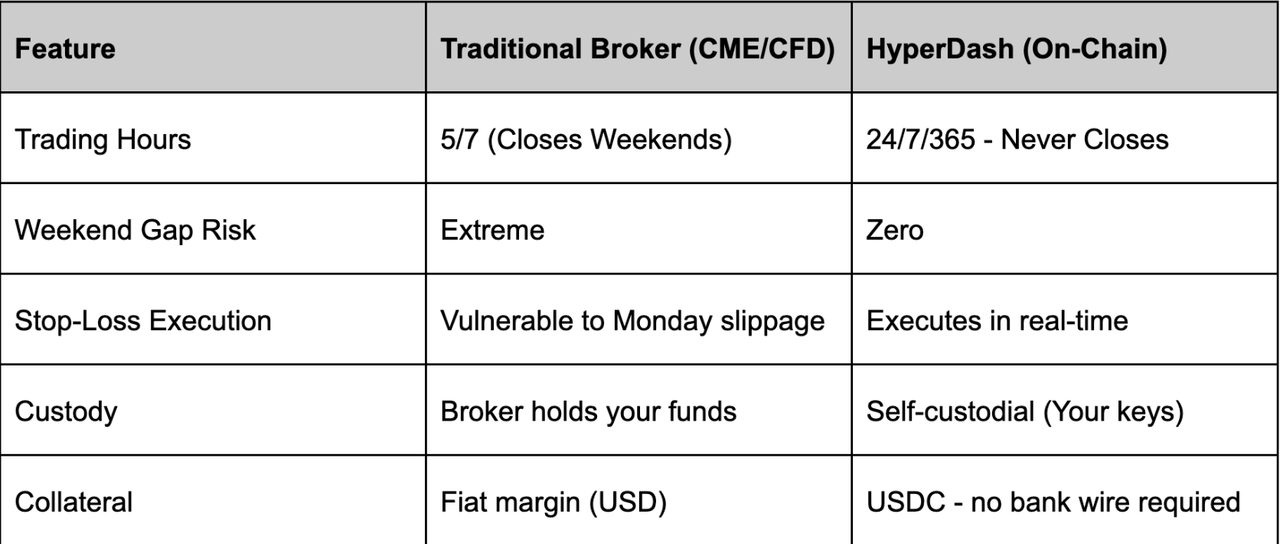
Traditional Broker vs. 24/7 On-Chain Trading
This comparison table highlights a structural shift in how markets operate. Traditional brokers are bound by limited hours, weekend gap risk, and intermediary custody, while Hyperdash runs continuously with real-time execution and self-custody.
Check it out:
The Solution: Trading Oil 24/7 on Hyperdash
The only way to safely trade Strait of Hormuz volatility is to use an infrastructure that stays open when the crisis actually happens. By trading WTI Crude Oil perpetual futures on the Hyperliquid L1 blockchain via the Hyperdash terminal, you eliminate weekend gap risk entirely.
Step 1: Fund Your Account with USDC
To trade oil on-chain, you don’t need a fiat bank wire that takes three days to clear. You simply need USDC. Connect your wallet to Hyperdash and deposit USDC into your account. This collateral allows you to trade crypto, equities, and commodities from a single balance.
Step 2: Monitor the CL-USDC Market
Navigate to the WTI Crude Oil (CL) price in Hyperdash. Because this is a perpetual futures contract, it tracks the price of global crude oil precisely but trades continuously, 24 hours a day, 7 days a week.
Step 3: Set Your Stop-Losses with Confidence
Because Hyperdash never closes, your stop-loss orders are active through the weekend. If a headline breaks on Sunday morning that sends oil prices soaring, your protective stops will execute exactly where you placed them, protecting your capital from Monday morning slippage.
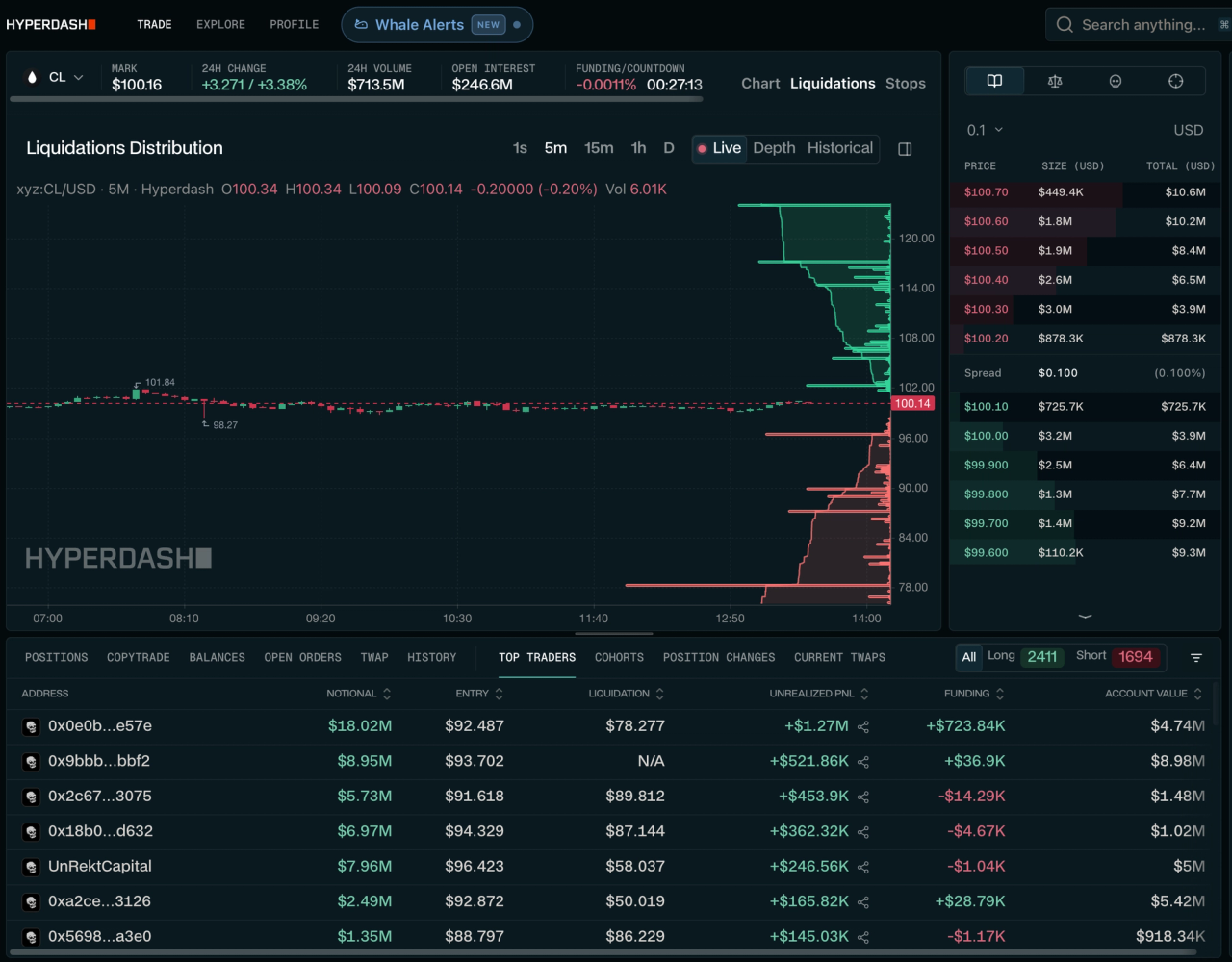
Step 4: Use the Liquidation Heatmap
During high-volatility events, novice traders often get liquidated on violent price wicks. Use Hyperdash’s Real-Time Liquidation Heatmap to see exactly where other traders have placed their stops. You can use this data to place your limit orders just below these clusters, buying the panic when others are forced to sell.
Conclusion: Don’t Trade Blind
Geopolitical volatility in the Strait of Hormuz is not going away. As long as 20% of the world’s oil flows through that narrow channel, the risk of sudden supply shocks remains high. If you are still trading oil on a platform that closes on Friday at 5:00 PM, you are not managing risk, you are simply hoping nothing happens over the weekend.
Take control of your execution. Trade the news as it happens, not when your broker decides to open.
Start Trading Oil 24/7 on Hyperdash
Frequently Asked Questions
What is the best way to trade Strait of Hormuz volatility?
The safest and most efficient way to trade geopolitical volatility in the oil market is through 24/7 on-chain perpetual futures, such as the CL-USDC market on Hyperdash. Don't wait for Monday, this prevents you from being locked out of your positions during weekend news events.
Why do oil prices gap on Mondays?
Oil prices gap on Monday mornings because traditional futures markets (like the CME) are closed over the weekend. If a major geopolitical event occurs on Saturday, the market cannot price it in gradually. When trading resumes, the price instantly jumps (or drops) to reflect the new reality, bypassing any stop-loss orders placed within the gap.
Can I trade oil with crypto?
Yes. Using the Hyperdash terminal, you can use USDC as collateral to trade WTI Crude Oil (CL) perpetual futures directly on-chain, with no fiat conversion required.
Disclaimer: This article is for informational purposes only and does not constitute financial advice. Trading perpetual futures involves significant risk. Always conduct your own research before deploying capital.