Learn How to Trade Oil 24/7: The Complete Guide

May 14, 2026
By Hyperdash
In this guide, we’ll explain exactly how 24/7 oil trading works, including the history, background, and mechanics. While traditional venues close down at set times, platforms like the Hyperdash terminal create a trading environment that never turns off allowing for always on crude oil trading through perpetual contracts.
Published
May 14, 2026
Author
Hyperdash
Reading time
4 min read
Category
Trading Basics
1. The Problem: The Weekend Blind Spot in Traditional Oil Markets
For decades, the global oil market has been handcuffed by the operating hours of traditional financial institutions. The Chicago Mercantile Exchange (CME), where the vast majority of oil derivatives are traded, operates on a strict schedule. It closes on Friday evening and doesn't reopen until Sunday night.
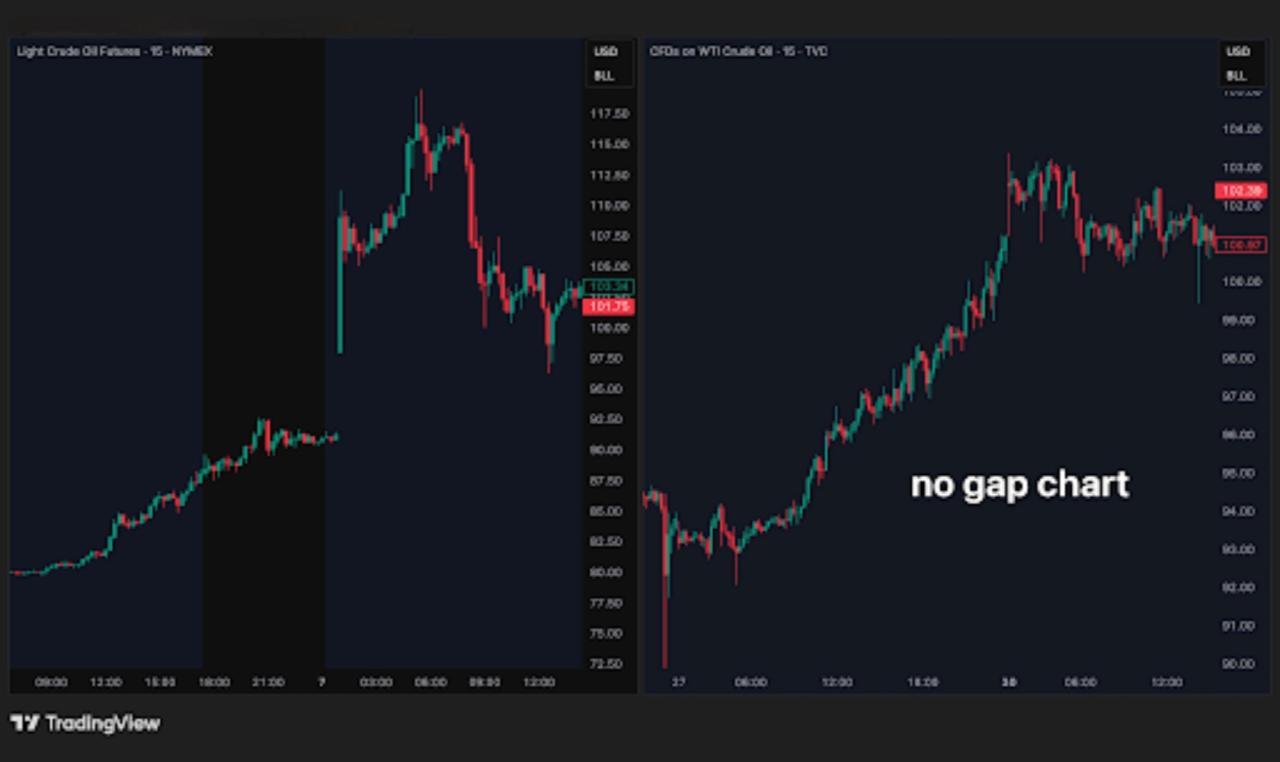
As we saw during recent escalations in the Middle East, major news events often break on Saturdays and Sundays. For traditional traders holding oil positions, this creates a terrifying "weekend blind spot." It's time we fix that and our platform is leading the charge.
The Cost of Trading Blind
When a geopolitical shock occurs while markets are closed, traders cannot adjust their positions. They are forced to wait until the Monday open, often facing massive "gap downs" or "gap ups" that trigger liquidations or wipe out profits.
Geopolitics don't take the weekend off. Futures gap up and down from the Friday close to the Sunday night open. Here's what can happen to traders holding over the weekend:
- Unhedged Exposure: You cannot react to breaking news.
- Gap Risk: The price at the Monday open can be vastly different from the Friday close.
- Missed Alpha: You miss out on the initial volatility following a major event.
2. The Solution: On-Chain Perpetual Futures
The crypto industry solved the 24/7 trading problem years ago because of their ability to trade 24/7 365. Now, that same infrastructure is being applied to real-world assets (RWAs) like oil and gold. On Hyperdash, we're helping to bring that model to assets such as:
What are Oil Perpetuals?
A perpetual future (or "perp") is a derivative contract that tracks the price of an underlying asset without an expiration date. In the context of oil, these contracts track indices like WTI crude.
Instead of dealing with physical delivery or expiring contracts, traders use stablecoins (like USDC) as collateral to go long or short on the price of oil. A mechanism called the "funding rate" ensures the price of the perpetual contract stays pegged to the actual spot price of oil.
At Hyperdash, we've made this possible and the tipping point for this new market has been Hyperliquid, a decentralized exchange (DEX) built on its own Layer-1 blockchain. Unlike older DEXs that relied on slow automated market makers (AMMs), Hyperliquid uses an on-chain limit order book.
According to a recent report by JPMorgan, daily trading volume for the WTI crude oil contract (CL-USDC) on Hyperliquid spiked to $1.7 billion during a single weekend in March 2026. Why? Because traders needed to hedge their exposure while the CME was closed.
3. Why Trade Oil on Hyperdash?
While Hyperliquid provides the underlying blockchain and liquidity, Hyperdash provides the professional-grade terminal required to execute complex strategies.
If you are transitioning from a traditional broker or a centralized exchange, Hyperdash offers an upgraded feel, look, and platform. That means the high-performance interface you need, combined with the benefits of decentralized finance (DeFi).
Hyperdash provides advanced tools specifically designed for perpetuals traders:
- Real-Time Liquidation Heatmaps: See where other traders' stop-losses and liquidation points are clustered.
- Whale Tracking: Monitor large on-chain positions in real-time.
- Advanced Order Types: Execute precision entries and exits with limit, stop-loss, and take-profit orders that work while you sleep.
4. Step-by-Step: How to Trade Oil 24/7 on Hyperdash
Ready to escape the weekend blind spot? Here is exactly how to start trading the CL-USDC perpetual contract on Hyperdash.
Step 1: Create Your Account
Hyperdash is a non-custodial platform. You do not need to create an account with an email and password. Instead, you connect a Web3 wallet (like MetaMask or Rabby). This ensures you retain total control of your funds.
Step 2: Select the CL-USDC Market
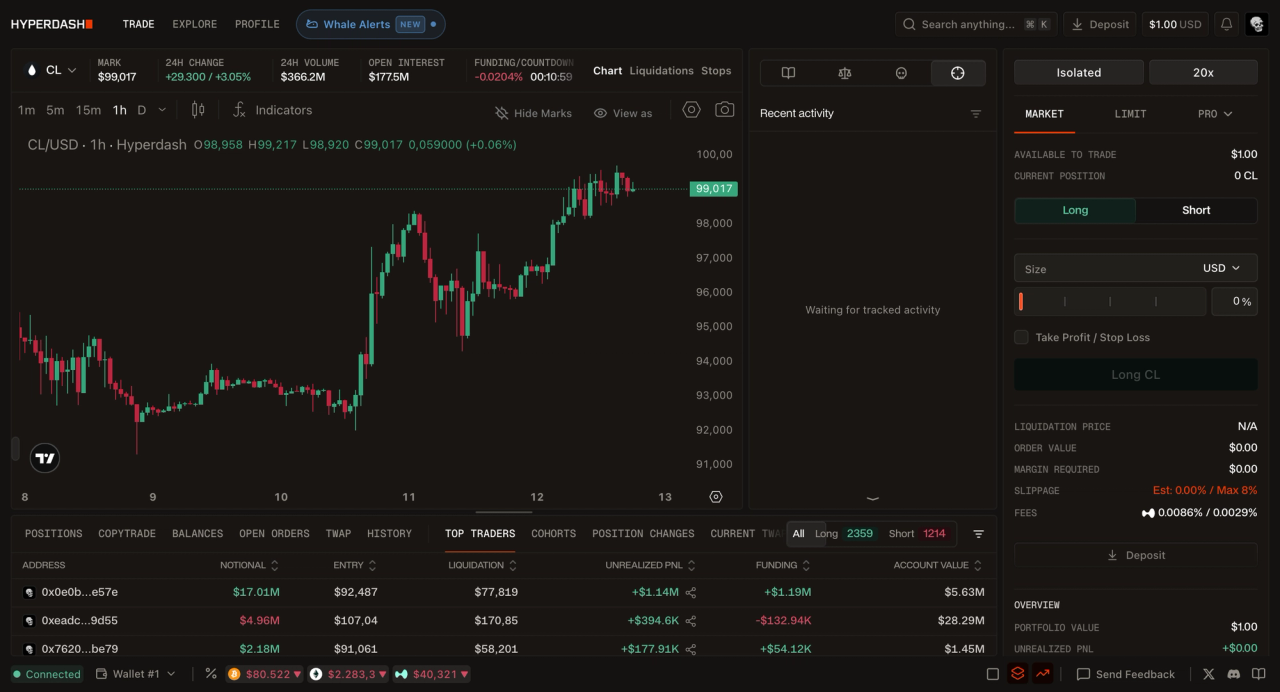
Navigate to the trading terminal and select the CL (WTI Crude Oil) market from the asset dropdown. You will immediately see the live, 24/7 order book and price chart.
Step 3: Plan Your Trade
- Choose your direction: Decide whether you want to go Long (buy) or Short (sell).
- Set your leverage: Hyperliquid allows up to 20x leverage on oil. Note: Leverage amplifies both profits and losses. Use strict risk management.
- Select order type: Use a Market order for immediate execution, or a Limit order to specify your exact entry price.
- Manage Risk: Always set a Stop-Loss order to protect your capital.
The Future is Always-On
The migration of commodity trading to the blockchain is not a fad; it is a structural upgrade to global finance. The $1.7 billion weekend volume on Hyperliquid proves that when given the choice, traders will always opt for continuous, permissionless access.
By utilizing the Hyperdash terminal, you can trade oil 24/7, hedge your portfolio against weekend geopolitical shocks, and operate with the speed and self-custody that modern markets demand.
Frequently Asked Questions (FAQ)
Is trading oil on crypto platforms legal?
Yes, but availability depends on your jurisdiction. Hyperliquid and Hyperdash do not serve users in the United States or other restricted regions. Always check your local regulations.
What is the ticker for oil on Hyperliquid?
The ticker for the WTI crude oil perpetual contract is CL.
Do I own physical oil?
No. You are trading a perpetual futures contract that tracks the price of oil. You are speculating on the price movement, not taking delivery of physical barrels.
Disclaimer: Trading perpetual futures involves significant risk and can result in the loss of your invested capital. This article is for informational purposes only and does not constitute financial advice. Do not trade with money you cannot afford to lose.