What are Hyperliquid Improvement Proposals (HIPs)?
June 23, 2025
By Hyperdash
As the Hyperliquid blockchain grows, upgrades like builder-deployed perpetuals and token standards keep rolling out, but the process behind them often stays in the shadows. That’s where Hyperliquid Improvement Proposals (HIPs) come in. They’re the silent mechanism steering HyperCore, Hyperliquid RPC nodes, and more. Once you understand them better, every technical release makes more strategic sense.
Published
June 23, 2025
Author
Hyperdash
Reading time
5 min read
Category
Hyperliquid 101
What are Hyperliquid Improvement Proposals (HIPs)?
Hyperliquid Improvement Proposals (HIPs) are how the protocol upgrades itself cleanly, modularly, and without requiring forks. Each HIP introduces a focused change to core infrastructure, smart contract logic, or developer tooling. These proposals are authored by builders, reviewed by the community, and implemented directly into the Hyperliquid stack via HyperCore.
- HIP-1: Native Token Standard
- HIP-2: Hyperliquidity
- HIP-3: Builder-Deployed Perpetuals
These define how the Hyperliquid blockchain grows without halting the chain or pushing upgrades off-chain. Let us now understand each in detail:
HIP-1: Native Token Standard (November 2023)
The first Hyperliquid Improvement Proposal, or HIP-1, introduced a formal token standard to Hyperliquid blockchain, beginning with the PURR memecoin and later extending to the native HYPE token, making them fully compatible with HyperCore.
What are the key elements?
- Unique asset ID: the deployment transaction generates a globally unique hash that indexes each token on-chain
- Capped supply: every HIP-1 token is fungible, with a maximum supply set at genesis
- Rich metadata: includes name (up to 6 characters, like “HYPE” or “PURR”) and decimal precision (
weiDecimalsandszDecimals)
When PURR launched as the first HIP-1 token in April 2024, it immediately activated its spot market with order-book support without any custom setup. That smooth launch showed how HIP-1 empowered tokens to work directly on HyperCore, enabling spot trading against USDC and tooling from day one.
HIP-2: Hyperliquidity (March 2024)
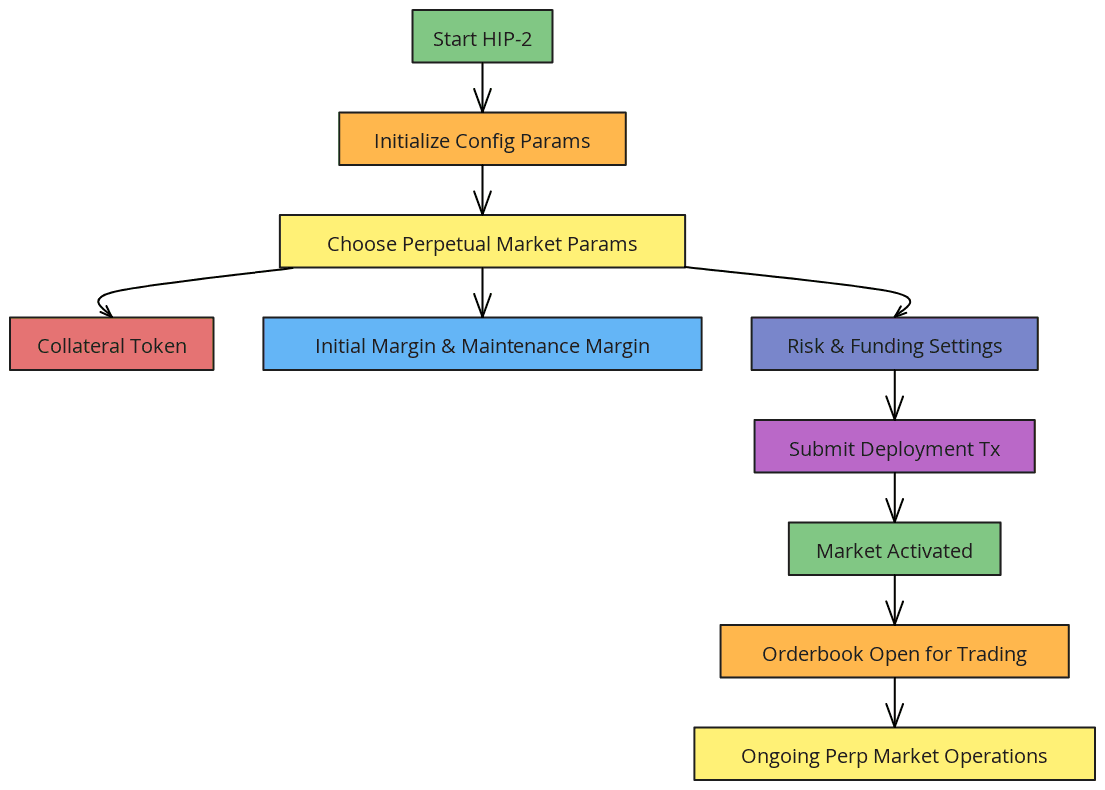
HIP-2 is one of the more groundbreaking Hyperliquid Improvement Proposals (HIPs), as it introduced Hyperliquidity, an on-chain liquidity mechanism built right into HyperCore. It automatically places buy and sell orders around a token’s current price. Hyperliquidity is an on-chain strategy built into HyperCore that automatically places buy and sell orders for new tokens, contributing continuous liquidity to the spot order book and supporting stable price execution without manual intervention.
What are the main traits?
- Fully permissionless, on-chain, and validator-secured
- No AMMs or third-party bots
- Built into the block logic for native performance
- Real example: When the PURR/USDC spot market launched, Hyperliquidity seeded initial depth instantly, allowing real trades before human liquidity arrived.
HIP-3: Builder-Deployed Perpetuals (October 2025)
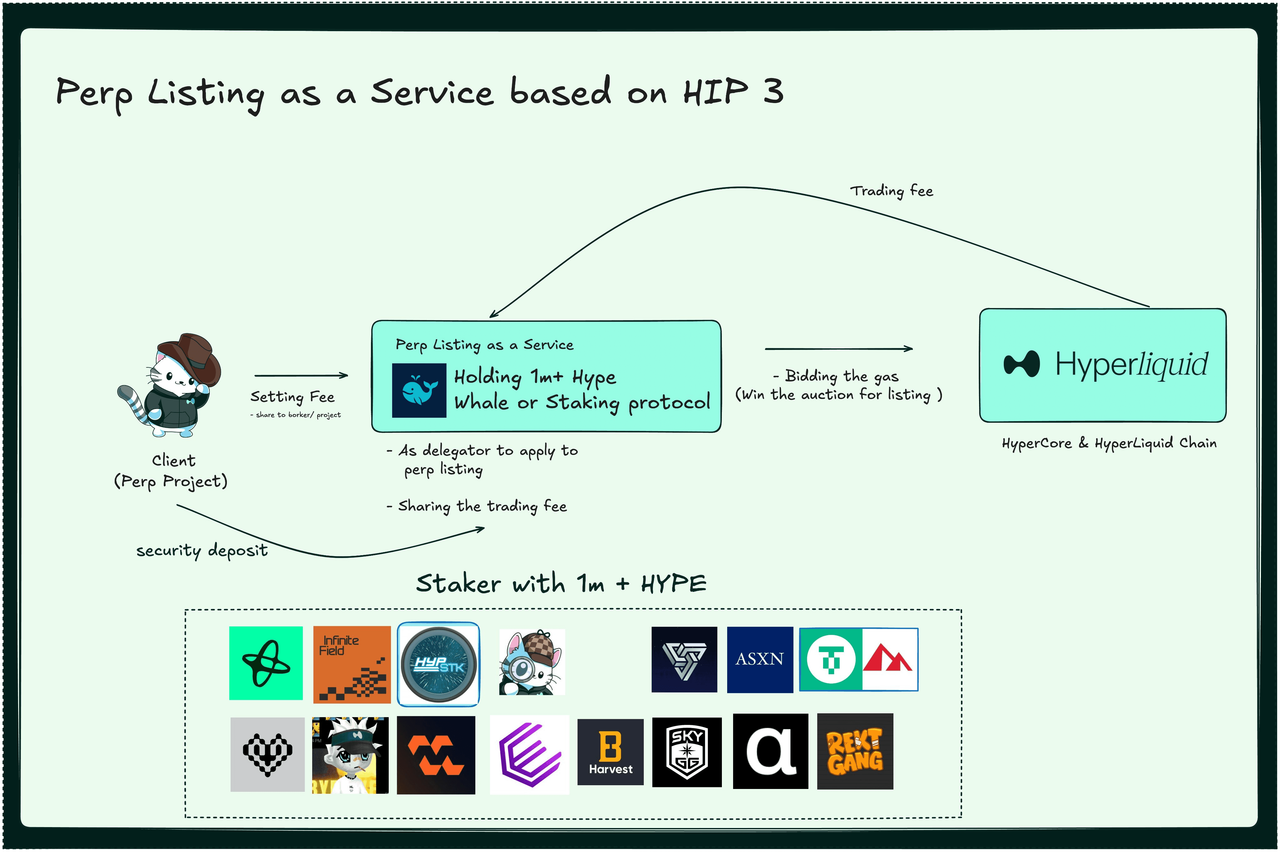
HIP-3 enables anyone to launch their on-chain perpetual markets directly on HyperCore, using HYPE for deployment gas.
How does it work?
- Deployers define the market (asset, oracle, fees)
- The first 3 assets in each perp dex need no auction; additional assets are paid via a 31-hour Dutch auction in HYPE
- Deployers can set an additional fee share of 0% to 300% (0% to 100% in growth mode)
- Requires a 500,000 HYPE stake on mainnet, maintained for at least 183 days after the dex is deployed, to prevent spam, helping align incentives for market deployers.
- Validators can slash bad actors, including during the 7-day unstaking queue
- HIP-3 has been activated on mainnet since October 2025, enabling permissionless deployment of perpetual markets on Hyperliquid’s core infrastructure.
- How it works: Dutch auctions begin at a high price and decrease over time until someone accepts the current price. This approach helps surface fair market value and avoids bidding frenzies. On Hyperliquid, it’s part of the mechanism to launch assets fairly, reinforced by a 500,000 HYPE stake requirement.
Why HIPs Matter for Hyperliquid
Every blockchain needs a way to grow, but most rely on governance overhead, off-chain proposals, or full protocol forks. Hyperliquid Improvement Proposals (HIPs) solve that differently by embedding the upgrade logic directly into HyperCore and making change modular, reviewable, and immediate.
Whether it’s launching new tokens (via HIP-1), seeding liquidity (via HIP-2), or testing permissionless market creation (via HIP-3), HIPs show how protocol decisions can be made with builder intent, not a bureaucratic process. For developers, this means faster iterations. For the chain, it means upgrades that don’t break things; they compound.
Closing Thoughts: Hyperliquid Improvement Proposals (HIPs)
The first three Hyperliquid Improvement Proposals (HIPs) introduced structure, liquidity, and permissionless market creation. They set the foundation, but they’re only the beginning. HIP-4 has since added outcome markets. As Hyperliquid blockchain grows, upcoming proposals will likely focus on risk engines, oracles, and validator tooling. The goal is to push more logic on-chain and remove friction across the stack. HIPs do not follow a token-weighted DAO voting process. Instead, proposals are evaluated based on technical readiness, implementation quality, and protocol impact before being integrated into Hyperliquid’s on-chain logic.
HIPs are your starting point if you're building on HyperCore or watching RPC developments. They don’t just describe changes. They show how the network thinks and where it’s going. Each one is a signal of what comes next.
FAQs
How are HIPs approved in the Hyperliquid ecosystem?
HIPs do not follow a token-weighted DAO voting process. Instead, proposals are evaluated based on technical readiness, implementation quality, and protocol impact before being integrated into Hyperliquid’s on-chain logic. HIPs are reviewed by core builders and evaluated based on technical merit, impact, and code-readiness, then deployed natively.
Can external developers propose a HIP?
Yes. While most HIPs have come from the core team, any builder with a strong case and working code can publish one.
Where can I track upcoming or proposed HIPs?
The best place is the HIPs section of the Hyperliquid docs or the official Discord. Early-stage drafts and timelines are shared there first.
Can developers outside the core team contribute to HIP implementations?
They can. Most early HIPs came from Hyperliquid’s core team, but the door’s open for others, too. As long as a proposal gains support and clears the usual steps, like community feedback, testing, and governance, it can move forward. Independent builders can contribute at any stage, from writing code to stress-testing updates. It’s all part of making the protocol more open over time.