What Is HYPE? Hyperliquid’s Native Crypto Explained
August 14, 2025
By Hyperdash
HYPE token is Hyperliquid’s native cryptocurrency. It powers staking, governance, and on-chain utility across the blockchain's HyperCore and HyperEVM layers. Launched via a community airdrop in late 2024, HYPE lies at the heart of Hyperliquid, a high-performance Layer-1 decentralized exchange (DEX) platform. The token aligns incentives for validators, developers, and DeFi power users across the protocol.
Published
August 14, 2025
Author
Hyperdash
Reading time
4 min read
Category
Hyperliquid 101
What Is HYPE Token?

HYPE is the foundation of the Hyperliquid blockchain and governance system. As the network’s utility token, HYPE plays three core roles:
- Governance: HYPE stakers choose the validators that vote on protocol decisions, and each validator's vote is weighted by the HYPE staked to it
- Staking: Delegators stake tokens to support network security via Hyperliquid Validators, earning emissions-based rewards in return.
- Gas utility: HYPE is used to pay transaction fees, especially on HyperEVM, where it is the native gas token
In short, the HYPE token connects protocol utility, ownership, and community participation into a single asset.
HYPE Staking and Hyperliquid Validators
Hyperliquid blockchain validators are block-producing nodes operating under the HyperBFT consensus model. They secure the network and enable sub-second transaction finality, with a median end-to-end latency of 0.2 seconds for orders, ensuring trades are irrevocably confirmed in a single block.
Delegators stake HYPE to their chosen validator and earn rewards paid from the future emissions reserve, at a rate that falls as total stake rises (about 2.37% a year at 400M HYPE staked, per the official staking docs). Trading fees do not go to stakers: they flow to HLP, deployers and the Assistance Fund, which buys back HYPE. Staking flows, the validator set and the largest stakers can be tracked through the Hyperdash Data API.
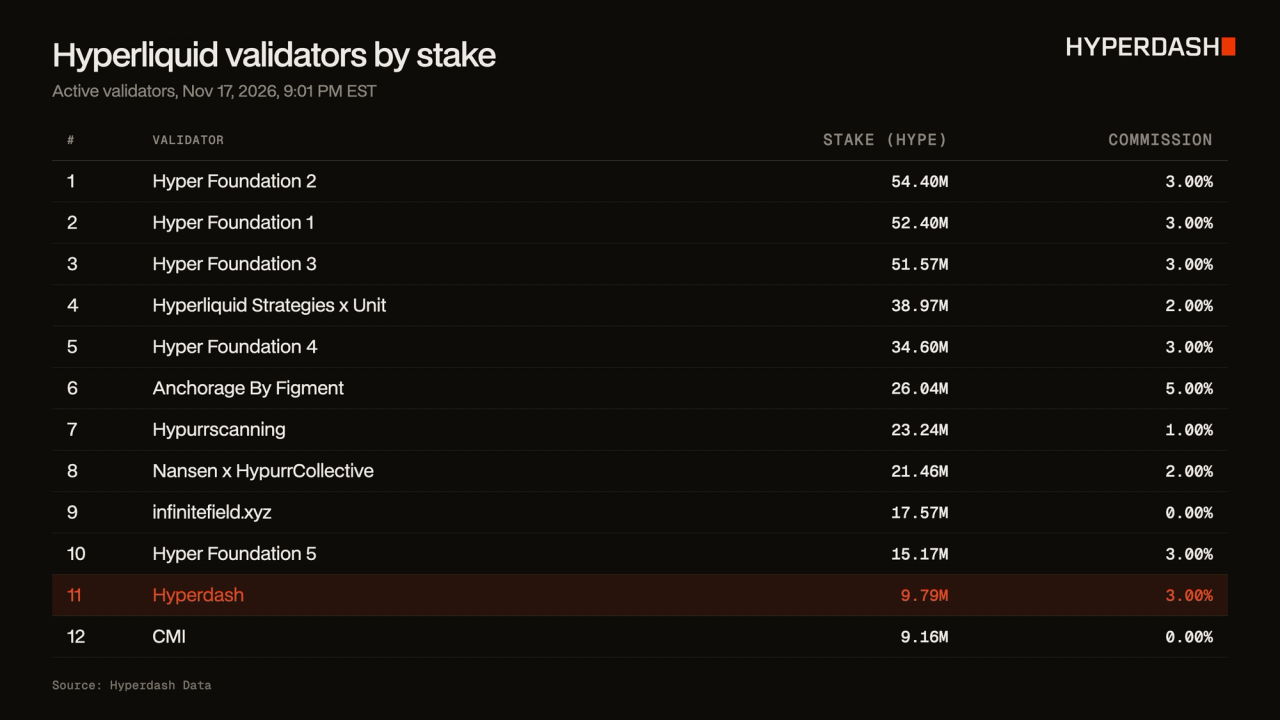
The staking system is designed with staker protection in mind and ensures:
- A 1-day lockup on each delegation and a 7-day unstaking queue before tokens return to the spot balance, which enforces commitment
- Limits on the validator commission rate: a validator cannot raise its commission unless the new rate is 1% or lower, which prevents sudden fee hikes
- Jailing of validators that do not keep up with consensus (a jailed validator earns no rewards for its delegators), which helps to maintain validator reliability
By staking HYPE, users earn passive rewards while reinforcing the decentralization and security of Hyperliquid.
HyperCore and HyperEVM
Hyperliquid runs on a dual-layer architecture: HyperCore and HyperEVM, which is designed for speed, composability, and on-chain governance.
- HyperCore is the high-performance execution layer. It handles the on-chain order book, validator consensus, and block production with near-instant finality.
- HyperEVM is a built-in, fully EVM-compatible smart contract environment built directly into HyperCore’s ledger that helps developers deploy Solidity-based dApps directly on Hyperliquid without needing bridges or external VMs.
Together, this structure allows the HYPE token to serve two critical functions:
- On HyperCore, HYPE is staked to secure the network and participate in validator rewards
- On HyperEVM, HYPE is used as gas to execute smart contracts
This architectural synergy allows HYPE to power both performance and participation.
What Are Hyperliquid Improvement Proposals?
Hyperliquid blockchain governance is designed to be on-chain and transparent. Hyperliquid Improvement Proposals (HIPs) define new protocol primitives, such as HIP-1 native tokens, HIP-3 builder-deployed perpetuals and HIP-4 outcome markets, and each one is documented in the official HIP docs. HYPE token holders do not vote on HIPs directly. They take part by staking: validators vote with the stake delegated to them, and through these votes they can:
- Delist validator-operated perps
- Slash HIP-3 deployers for irregular market operation, or remove a token's quote asset status
- Approve the outcome templates that HIP-4 deployers use to launch markets
These votes happen on HyperCore, not on HyperEVM. Each vote is weighted by stake and recorded on-chain, so every decision is transparent and verifiable.
Closing Thoughts: Why HYPE Matters
HYPE is more than Hyperliquid blockchain’s native token. It is the key to building, governing, and growing the network. Builders stake HYPE to secure the protocol, earn rewards, back the validators that vote on protocol decisions, and fuel smart contracts on HyperEVM with speed, liquidity, and upgradeability. Power users gain influence and incentives, shaping Hyperliquid’s direction while benefiting from its performance and rewards. By uniting ownership, utility, and governance in a single asset, HYPE empowers its community to drive the evolution of a high-performance, decentralized future.
FAQs
What is the main purpose of the HYPE token on Hyperliquid?
HYPE serves as Hyperliquid’s native cryptocurrency, powering governance, staking, and gas fees across the network’s HyperCore and HyperEVM layers.
How do Hyperliquid validators secure the network?
Validators are block-producing nodes operating under the HyperBFT consensus model, achieving sub-second transaction finality and ensuring trades are confirmed in a single block.
What role does HyperEVM play in HYPE’s utility?
HyperEVM is a fully EVM-compatible smart contract environment within HyperCore, where HYPE is used as the native gas token for deploying and executing dApps without bridges or external VMs.
How can HYPE holders participate in governance?
HYPE holders take part by staking to validators. Validators vote on protocol decisions such as perp delistings, HIP-3 deployer slashing and quote asset status, and each vote is weighted by the HYPE staked to that validator and recorded on-chain.