Hyperdash vs. eToro: The Best Copytrading and Perpetuals Platform
June 17, 2026
By Hyperdash
Copy trading promised to democratize investing. The idea was simple: find a profitable trader, mirror their moves, and let expertise do the work. eToro built an empire on that promise, and for a while, it delivered. But in 2026, the infrastructure underneath that promise has changed fundamentally, and the traders who understand the difference are quietly migrating to a new model.
The shift is from CFD-based social trading to on-chain perpetual futures. It is not a marginal upgrade. It is a structural one, affecting fees, market access, execution quality, and the quality of the intelligence you can extract from the traders you follow.
This article breaks down exactly what separates Hyperdash from eToro, and why the best copytrading platform in 2026 looks nothing like it did in 2020.
Published
June 17, 2026
Author
Hyperdash
Reading time
8 min read
Category
Tools & Data
The Infrastructure Problem With CFD Copytrading
In 2026, the best copytrading platforms are transitioning from legacy Contract for Difference (CFD) models to decentralized perpetual futures. Platforms utilizing perpetuals offer 24/7 liquidity and eliminate the opaque spread markups common in traditional CFD brokers like eToro.
When you copy a trader on eToro, you are not copying their actual position. You are entering a Contract for Difference, a derivative instrument where eToro itself acts as the counterparty. This creates a structural conflict of interest that is well-documented by the Bank for International Settlements, which has flagged the inherent conflicts in retail derivatives platforms operating as market makers::
- eToro profits when you lose, because they are the market maker on the other side of your trade.
- Overnight swap fees (also called rollover fees) are charged on every CFD position held past market close, a cost that compounds silently over time.
- Trading hours are restricted. If a geopolitical event moves oil over the weekend, eToro users cannot act until Monday's open, by which point the move is already priced in.
On Hyperdash, the mechanics are fundamentally different. Trades are executed on-chain via Hyperliquid, a decentralized perpetual futures exchange. There is no counterparty conflict. The platform does not profit from your losses. Funding rates, the cost of holding a perpetual position, are transparent, publicly visible, and often far lower than CFD overnight fees.
For a full breakdown of how these costs compare, see Overnight Swap Fees Are Draining Your CFD Profits and Why Perpetuals Are Better Than CFDs 10 Times Out Of 10.
Copying Retail Noise vs. Following Smart Money
While traditional copytrading platforms rely on retail sentiment feeds, advanced perpetuals trading platforms aggregate institutional order flow. Hyperdash's Whale Alerts feature tracks high-impact orders across the network in real-time, providing an empirical edge over social feeds.
The fundamental question in copytrading is not 'who should I follow?', it is 'what data am I using to make that decision?'
On eToro, the selection criteria are largely social: number of followers, self-reported risk score, and a 12-month return figure. These metrics are gameable, backward-looking, and tell you nothing about what a trader is doing right now. The eToro Academy itself acknowledges that past performance is not indicative of future results, yet the platform's entire discovery mechanism is built on historical returns.
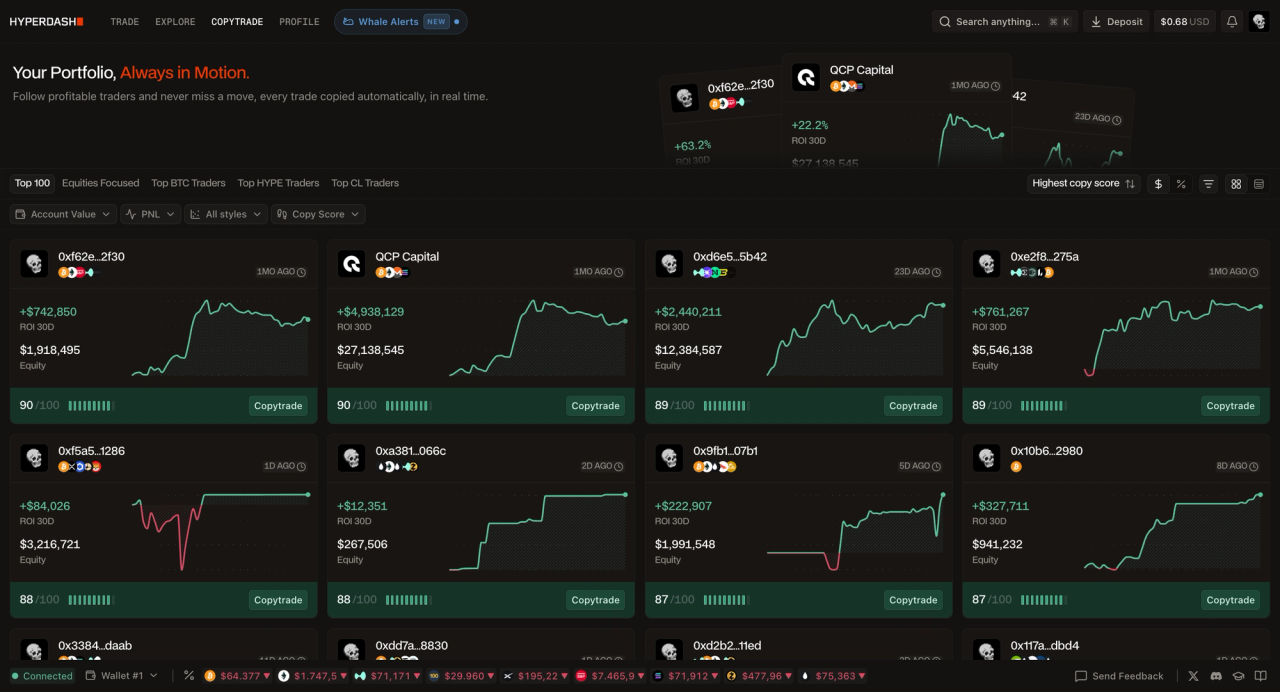
Hyperdash's Copytrade interface is built on a different data layer entirely. Every trader card on the platform displays:
- PnL (Unrealized): What the trader is making on open positions right now.
- ROI 300: Return on investment over the last 300 days, a longer, more defensible performance window.
- Equity: The actual capital the trader has at risk, which contextualizes their returns.
- Copy Score: A composite score (visible as a bar indicator) that aggregates performance consistency.
- Asset Exposure: Colored icons showing which asset classes the trader is active in equities, crypto, commodities, at a glance.
Beyond individual trader cards, Hyperdash layers in two features that have no equivalent on eToro:
The first is Whale Alerts, a real-time feed of high-notional orders being placed across the Hyperliquid network. When a wallet moves $30M into a short position on crude oil, Whale Alerts surfaces it instantly. This is the kind of order flow intelligence that, on traditional markets, is reserved for institutional desks.
The second is PnL Cohort Analysis. Rather than following one trader, Hyperdash allows you to observe the aggregate positioning of trader cohorts segmented by profitability; 'Extremely Profitable', 'Very Profitable', 'Unprofitable', and so on. When the most profitable cohort flips from bullish to bearish on an asset, that is a statistically meaningful signal. It is not one person's opinion. It is the collective positioning of the traders who have consistently made money on that asset.
To understand how to read these signals, see How to Use Whale Watching to Inform Your Trades and Best Analytics and Trading Tools for Hyperliquid in 2026.
24/7 Market Access: The Feature eToro Cannot Offer
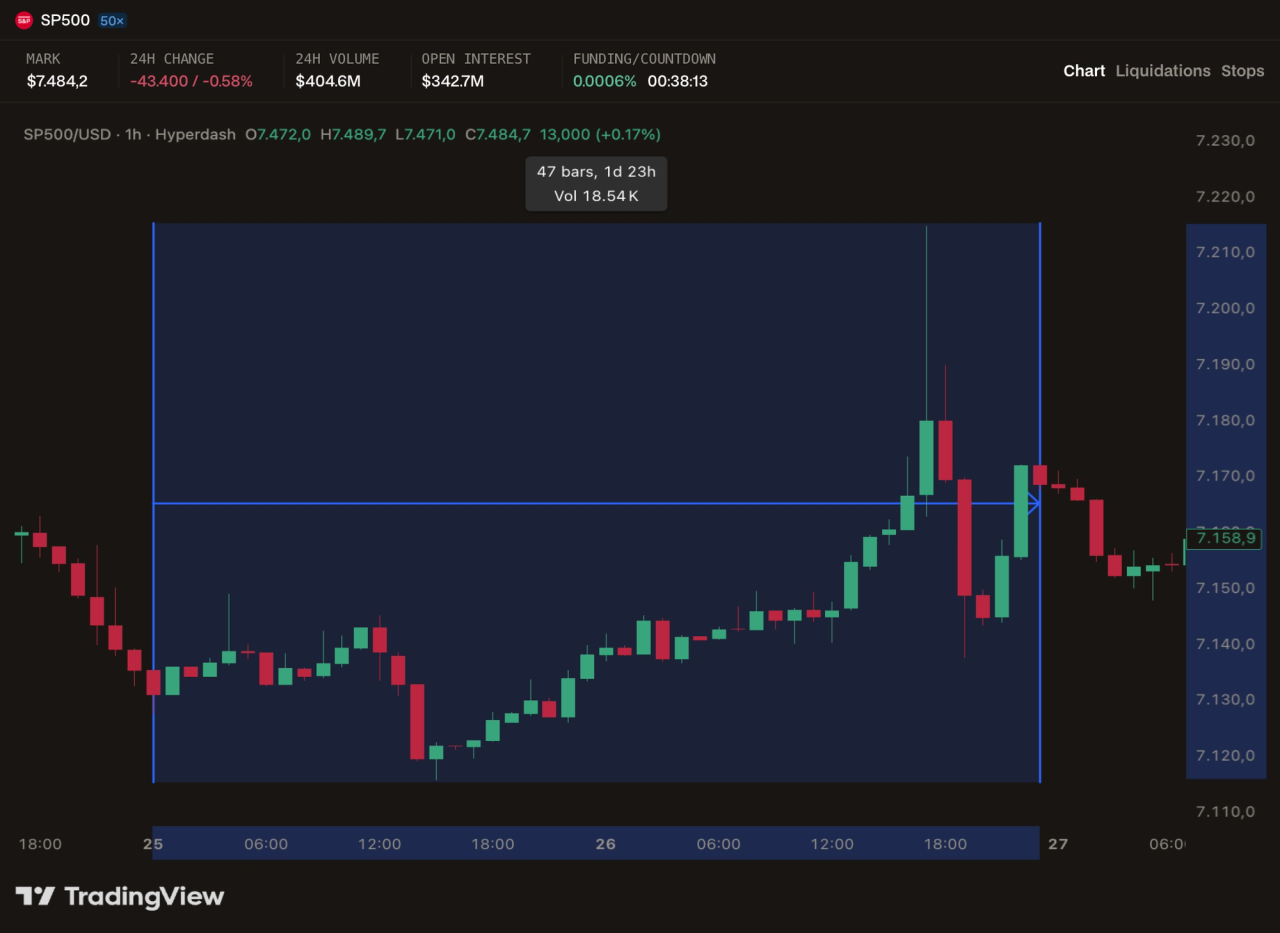
The primary limitation of legacy brokers is restricted trading hours for traditional assets. Hyperdash bridges this gap by offering 24/7 access to perpetuals on stocks, indices, and commodities, allowing traders to react to weekend geopolitical events instantly.
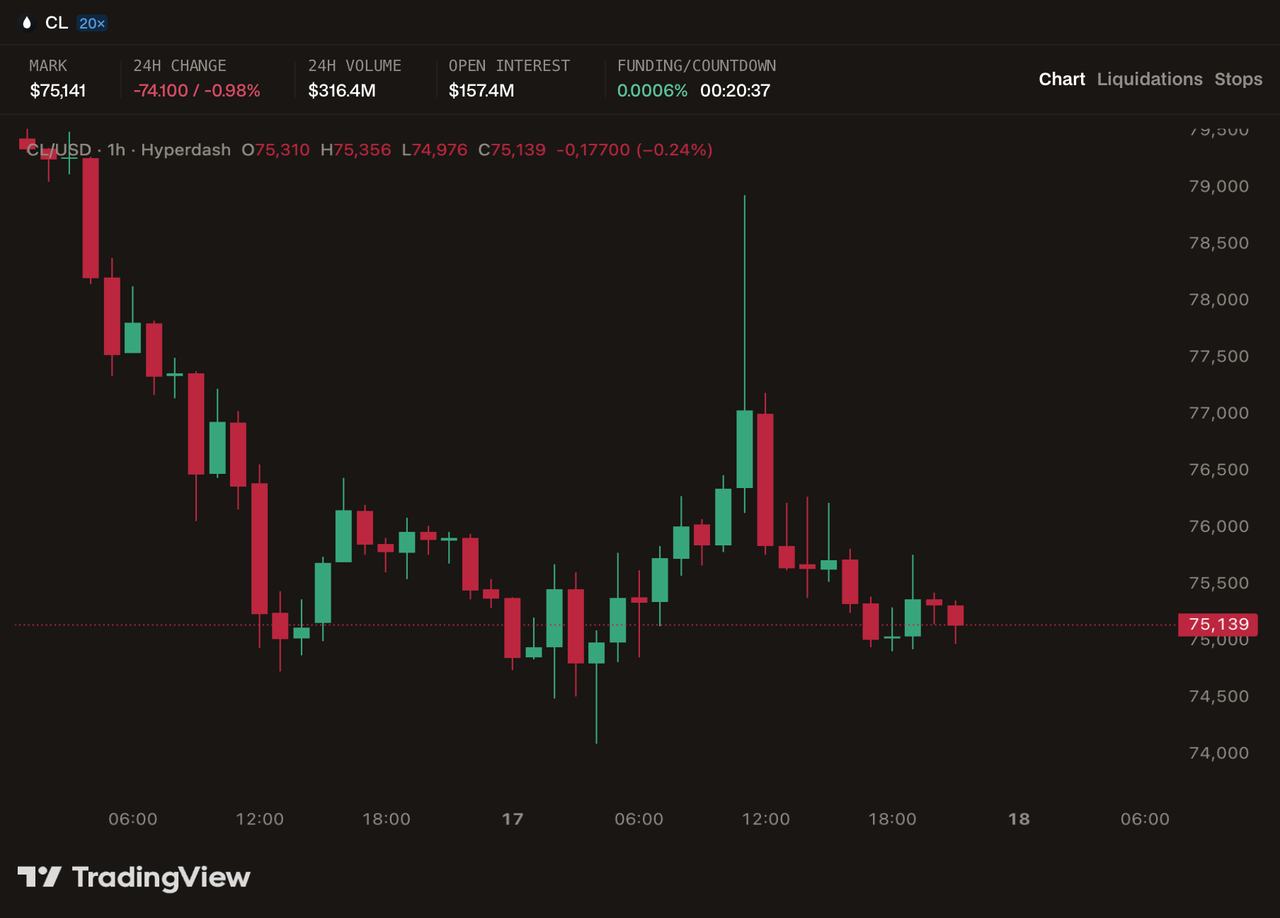
In April 2026, when news broke about the Strait of Hormuz, crude oil moved sharply over the weekend. eToro users woke up Monday to a gap they could not trade. Hyperdash users had been positioned, or had exited, hours earlier. We covered the mechanics of that trade in How To Trade The Strait of Hormuz 24/7 Including Saturday and Sunday.
This is not an edge case. It is the structural reality of trading in a world where geopolitical events, earnings leaks, and macro data do not respect exchange hours. According to CME Group, the majority of price discovery in commodity markets now occurs outside traditional exchange hours, a trend that has accelerated since 2022. Perpetual futures on Hyperdash trade 24 hours a day, 7 days a week, on assets including:
- Equities: NVDA, GME, SPCX, and many others
- Indices: S&P 500, Nasdaq 100, EWY, and others
- Commodities: WTI Crude Oil, Gold, and others
- Crypto: BTC, ETH, SOL, and the full Hyperliquid asset catalogue
For traders who have been using eToro to access traditional markets, this represents a fundamental expansion of what is possible, not just in terms of hours, but in terms of the precision of execution and the absence of artificial constraints.
For a deeper look at how 24/7 trading works in practice, see How to Trade Stocks on Saturday and Sunday and How to Trade Oil 24/7.
The Numbers Behind the Migration
The data on CFD trading outcomes is not ambiguous. As documented in our analysis of retail trading performance, 76% of CFD traders lose money, a figure that has remained consistent across regulatory disclosures in the EU, UK, and Australia for over a decade, and is independently tracked by the CFTC in the United States. This is not a failure of individual traders. It is a structural outcome of trading against a counterparty that profits from your losses.
The migration to on-chain perpetuals is, in part, a response to this data. Traders who understand the mechanics are not abandoning copytrading, they are upgrading the infrastructure it runs on. CoinGecko's derivatives market data shows that on-chain perpetual open interest has grown consistently quarter-over-quarter since 2023, with decentralized venues capturing an increasing share of volume previously held by CFD brokers.
On Hyperdash, the top trader on the Copytrade leaderboard at the time of writing, DCP Capital, shows a PnL of +$4,938,129 with $27,138,545 in equity and a copy score of 90. These are on-chain, verifiable figures. There is no self-reporting. There is no platform adjusting the numbers for marketing purposes. The blockchain is the audit trail.
How to Get Started on Hyperdash Copytrade
The onboarding process on Hyperdash is designed for traders who are comfortable with self-custody or prefer email-based access. There is no lengthy KYC process. Sign up with your wallet or email, deposit funds from anywhere, and start trading.
1. Browse the leaderboard:
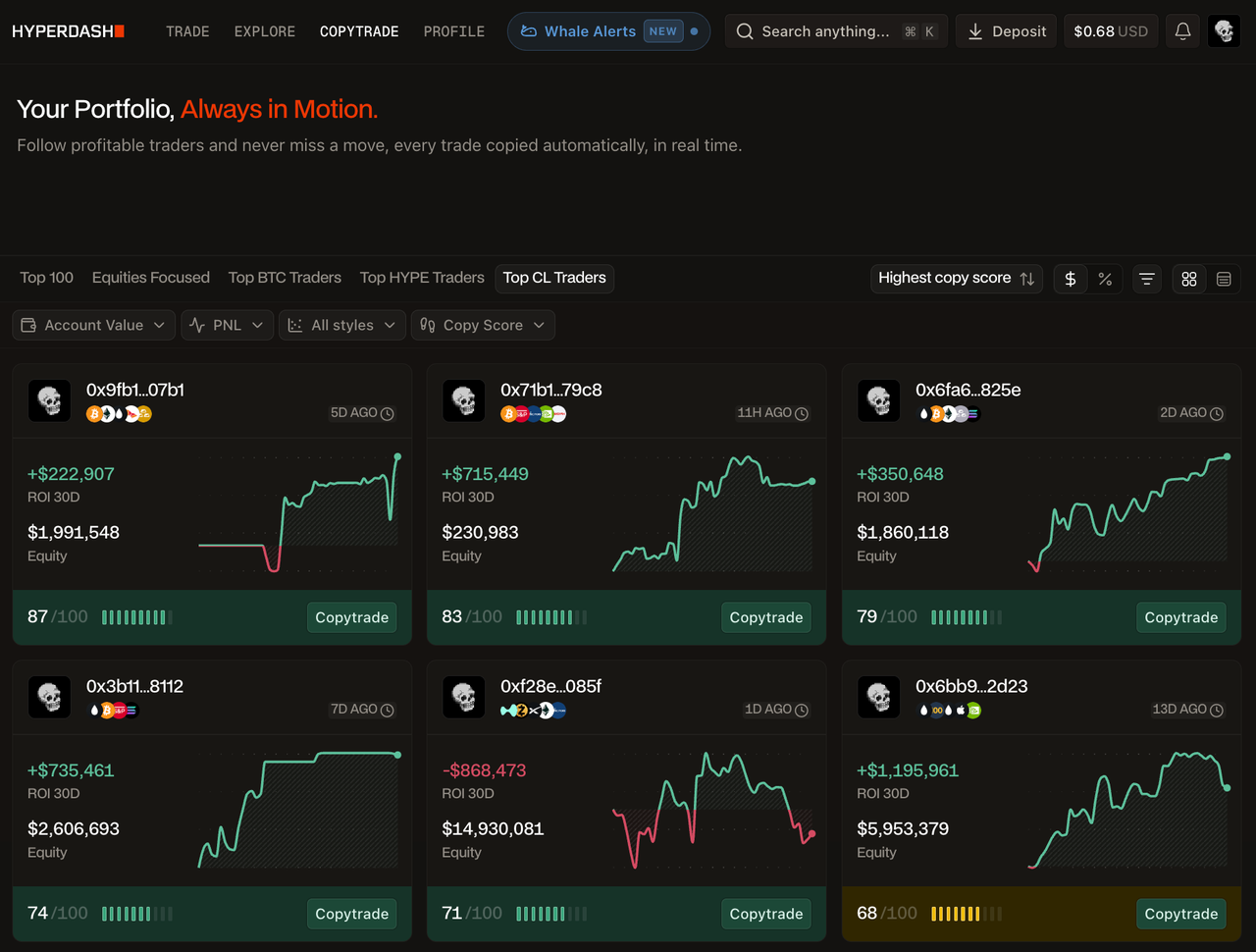
Navigate to hyperdash.com/copytrading. Use the filter tabs — Top 100, Equities Focused, Top BTC Traders, Top HYPE Traders, Top CL Traders — to find traders aligned with your asset focus.
2. Evaluate trader cards:
Each card shows PnL, ROI 300, equity, copy score, and asset exposure. Prioritize traders with high equity (skin in the game) and consistent ROI 300 over traders with a single large recent gain.
3. Check their cohort positioning:
Before copying, navigate to the asset they trade most and review the PnL Cohort panel. If the 'Extremely Profitable' cohort is positioned opposite to the trader you are considering, that is a meaningful signal.
4. Set your copy parameters:
Hyperdash allows you to set position size and risk parameters before activating a copy. Start with a defined allocation rather than a percentage of portfolio.
5. Monitor with Whale Alerts:
Once you are copying a trader, use Whale Alerts to stay informed about large order flow in the assets they trade. This gives you context for their moves in real time.
New to perpetuals? Start with Beginner's Guide to Perps Trading and How to Move From CFD Trading to Perpetual Futures before activating your first copy.
Frequently Asked Questions (FAQ)
What is the best copytrading platform for advanced traders in 2026?
For advanced traders, the best copytrading platform is one that provides on-chain transparency, 24/7 market access, and institutional-grade data tools. Hyperdash offers all three through its Copytrade leaderboard, Whale Alerts, and PnL Cohort Analysis; features that have no equivalent on legacy CFD platforms like eToro.
How does Hyperdash differ from eToro?
Hyperdash is built on perpetual futures via Hyperliquid, a decentralized on-chain exchange. eToro operates as a CFD broker, acting as the counterparty to your trades. The key differences are: Hyperdash offers 24/7 trading on traditional assets; all positions and PnLs are verifiable on-chain; there are no overnight swap fees; and the platform does not profit from user losses.
Can I copy trade traditional stocks and commodities on Hyperdash?
Yes. Hyperdash offers perpetual futures on equities (including NVDA, GME, SPCX), indices (S&P 500, Nasdaq), and commodities (WTI Crude Oil, Gold, Silver), all tradeable 24/7. The Copytrade leaderboard includes dedicated filters for 'Equities Focused' and 'Top CL Traders' to help you find specialists in each asset class.
Disclaimer
This article is for informational purposes only and does not constitute financial advice. Perpetual futures trading involves significant risk, including the potential loss of all invested capital. Past performance of traders on the Hyperdash Copytrade leaderboard is not indicative of future results. Always conduct your own research before making any trading decisions.