The Revolut USDT Delisting: Why EU Capital is Migrating to On-Chain Perpetuals

July 6, 2026
By Hyperdash
As Revolut forces the sale of USDT balances ahead of MiCA regulations, EU traders are moving capital off legacy apps and into decentralized perpetual futures.
Published
July 6, 2026
Author
Hyperdash
Reading time
6 min read
Category
Risk Management
The era of holding unrestricted stablecoins on European retail banking apps is ending.
On July 6, 2026, Revolut began notifying its European user base that Tether (USDT) will be fully delisted from its platform. The timeline is aggressive. Users have until August 31 to withdraw or sell their holdings. If they take no action, Revolut will automatically convert all remaining USDT balances into fiat currency at 12:00 UTC.
This is not an isolated policy decision affecting a small startup. Revolut commands an estimated 40 million users across the European Economic Area (EEA), accounting for 33% of all new digital accounts opened in Europe last year. The delisting is the direct enforcement of the Markets in Crypto-Assets (MiCA) regulation, which imposes strict capital and licensing requirements on stablecoin issuers operating within the European Economic Area (EEA). Because Tether has not secured an Electronic Money Institution (EMI) license under the new framework, compliant platforms like Revolut have no choice but to purge the $110 billion asset.
For casual retail users, this is an inconvenience. For active traders who use USDT as their primary unit of account and collateral, it is a structural disruption. The question is no longer whether to move capital, but where to deploy it next.
The Problem with the Licensed CEX Route
The immediate reaction for many traders is to migrate funds to a MiCA-compliant centralized exchange (CEX). But this introduces a new set of constraints.
While a compliant CEX allows European users to trade legally, the asset availability is fundamentally altered. You cannot simply transfer your USDT to a compliant European exchange and resume trading as usual, because those exchanges are also bound by the same MiCA rules prohibiting unauthorized stablecoins. You are forced to convert your capital into euro-backed stablecoins (like EURC) or USDC. While USDC transfer volumes have surged, reaching $1.21 trillion recently, converting to USDC on a centralized venue still leaves you trading in a walled garden.
Furthermore, legacy centralized platforms are increasingly restricting the leverage and derivative products available to EU residents. You are trading in a walled garden, cut off from the deepest orderbooks.
The Migration to On-Chain Perpetuals
When institutional and sophisticated retail traders face artificial constraints on centralized venues, capital naturally flows to the infrastructure that offers the least friction. In 2026, that infrastructure is decentralized perpetual futures.
We are seeing a clear migration of capital from legacy banking apps and restricted CEXs into self-custodial Web3 wallets. From there, traders are deploying USDC collateral directly onto high-performance L1s like Hyperliquid. The scale of this migration is already visible in the data. Hyperliquid processed $633 billion in trading volume in Q1 2026 alone, and its open interest recently topped $10 billion. At its peak, it captured 80% of decentralized perpetual trading volume.
The structural advantage here is absolute. By moving on-chain, you eliminate the counterparty risk of holding funds on a centralized app that can force-sell your assets or freeze your account. You trade directly from your wallet, maintaining full control of your capital. And because decentralized perpetuals operate globally, you retain access to deep liquidity across crypto (like BTC, ETH), equities (like, MSTR, SPCX), and commodities (like, Oil, gold) without the artificial leverage caps imposed by European retail brokers.
For traders accustomed to the hidden overnight fees of traditional brokers, the shift to perpetuals is particularly impactful. As we detailed in our CFDs vs. Perpetual Futures comparison, on-chain perpetuals use a transparent funding rate mechanism instead of opaque broker markups, making them a vastly superior instrument for both hedging and directional trading.
The “Deposit from Exchanges” Bridge
The friction point for many traders moving on-chain is the bridging process. Navigating multiple networks and gas tokens to fund a decentralized trading account can be complex.
Hyperdash solves this through the “Deposit from Exchanges” feature. If you are moving capital out of Revolut or a restricted CEX, you can route it directly to the Hyperliquid L1 from major exchanges (including Binance, Bybit, KuCoin, Gate, Coinbase, and Bitfinex) without manually managing gas fees or interacting with third-party bridge protocols.
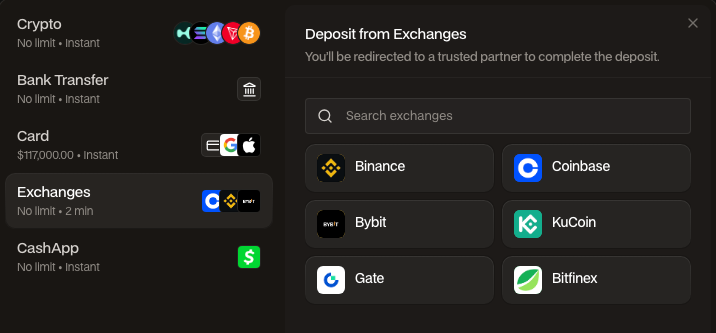
The process takes roughly 5 to 10 minutes. Once the USDC arrives, you have immediate access to the full Hyperdash analytics and trading terminal, including real-time liquidation heatmaps and cohort analysis, all executed with sub-50ms latency.
Trading Without Borders
The Revolut USDT delisting is a forcing function. It is accelerating a transition that was already underway: from closed, custodial trading apps to open, on-chain infrastructure. For EU traders, that transition now has a hard deadline.
Hyperdash is built for exactly this moment. It is a professional analytics and trading terminal running on top of Hyperliquid, one of the highest-performance decentralized exchanges in the world. Where Revolut offered a simplified interface with restricted assets and no leverage, Hyperdash gives you access to perpetual futures on crypto, equities, commodities, and indices (like S&P 500), all trading 24 hours a day, 7 days a week, with no artificial caps imposed by European retail regulation.
The data layer is what separates it from anything you have used on a centralized app. The liquidation heatmap shows you exactly where leveraged positions across the entire Hyperliquid network will be forced to close, giving you a structural read on where price is likely to move before it moves. The PnL Cohort panel segments every active wallet on the network by profitability, so you can see what the most consistently profitable traders are positioned in right now, not what they were positioned in last month. Whale Alerts surfaces the exact moment a large wallet adds or exits a position, in real time.
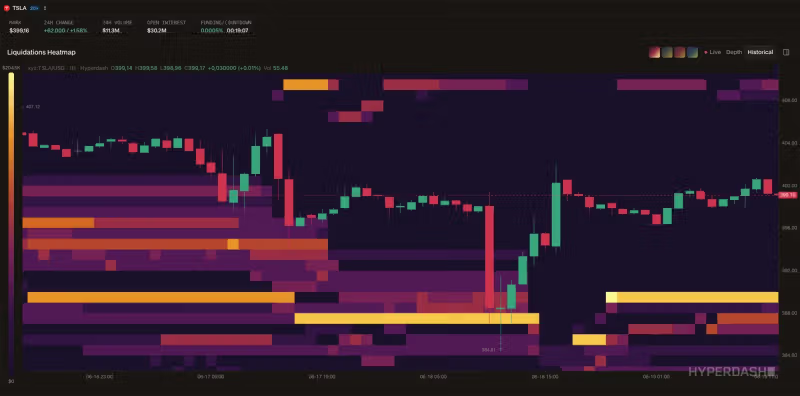
This is not a retail app with a prettier interface. It is the same infrastructure that institutional desks and quantitative traders use to operate on Hyperliquid, packaged into a terminal that any trader can access from day one.
For EU traders who have been constrained by what Revolut, eToro, or a MiCA-compliant CEX would allow, the migration to Hyperdash is not a compromise. It is an upgrade.
Sign up with your wallet or email, connect through the Deposit from Exchanges bridge, and access markets through Hyperdash.
Frequently Asked Questions (FAQ)
When is Revolut delisting USDT in Europe?
Revolut has set a final deadline of August 31, 2026. Users must withdraw or sell their USDT before this date.
What happens if I leave my USDT on Revolut after the deadline?
If you take no action, Revolut will automatically convert any remaining USDT in your account into fiat currency (such as Euros) on August 31.
Why is Revolut delisting Tether?
The delisting is required to comply with the European Union’s MiCA regulation, which mandates that stablecoin issuers hold specific licenses to operate in the region. Tether has not acquired the necessary EMI license.
Can I just move my USDT to a compliant European crypto exchange?
Compliant European exchanges are also subject to MiCA regulations and generally cannot support trading pairs or deposits for unauthorized stablecoins like USDT. You will likely need to convert to USDC or a euro-backed stablecoin.
Disclaimer: The information provided in this article is for educational purposes only and does not constitute financial, investment, or trading advice. Trading leveraged derivatives, including perpetual futures, carries a high level of risk and may not be suitable for all investors. You could lose some or all of your initial investment. Always conduct your own research and consult with a certified financial advisor before making any trading decisions.